Showing posts with label slam. Show all posts

Sunday, May 07, 2017

Take Away the "Take Away."

May I Suggest: Don't always tell people what to think about your stories.

As a Storyteller, you might need to learn to trust that the relationship between you and the audience is something that develops. First, it grows because of your ability to be open and accessible as a teller. Secondly, it grows because your audience is full of competent, life-living human beings. In all actuality, our role as storytellers is to help the audience discover for themselves their own understanding of the subject that we're talking about.

It's easy sometimes to think that when we finish telling a story, and this is especially true in telling personal stories, that we need to tell them why we have talked about the story that we just presented. It's as if we can't quite trust the audience to figure out for themselves what our story might mean in their own lives.

You know this essential truth: our stories must be appropriate for the audience that we're speaking to. If you practice this careful selection of well-crafted tales, then the audience won't struggle with the story that you told them. The time to be concerned about whether or not the audience understands why you are telling a story is in the crafting process. The time to be sure the audience understands is not at the end of telling the story, it's before you stepped on the stage.

When your story connects to world-sized Truths, there is no need for "here's the moral of the story" lecturing. Telling an audience what to think, what to "take away,"  rips the audience out of the transcendent experience of the story. It turns the teller into a preacher or teacher, not a storyteller.

Now there are times, of course, when you are telling stories in a teaching situation. In those roles, your stories will tend to be more didactic, and it's okay to walk the audience through a discussion about why you told the story the way that you told the story. And I would always encourage you to engage anyone who, after you telling, says, "Can we talk about that story?"


 However, I think that for most performance pieces, open-mic storytelling events, or personal storytelling nights, this "take away" habit that people are falling into now (explaining why they told the story) is really detrimental to the art form, to the storyteller and, I believe, to the audience.

Frankly, if you get to the end of your story and you feel you have to explain what the story is about, then you're not doing your deep work in crafting your story in the first place. It's simply too lazy to get to the end of your personal tale and then tell the audience what they should take away from your story. It falls back to, "Show, don't tell."

Let's be clear, your role as a storyteller of personal tales is to be the student of the experience you are describing. You are walking with the audience, not shoving them forward. Be ready to engage with audience members after your story, but start with what in your story resonates with them.

I'd invite you to work more intently on creating well-crafted stories so that the need to explain yourself the end of the story really is not existent. Facilitate understanding, don't preach. You'll be shocked how much you learn.

******
The is the official blog for K. Sean Buvala, storyteller and storytelling coach. My thanks to the very talented Mark Goldstein for the picture of me performing.

Sunday, April 19, 2015

Storytelling Slams: Cocktails, Canapes and Calliope

Like me, a calliope is sometimes full of hot air.
A bit of personal reflection: "Cocktails, Canapes and Calliope" is the new way that I am understanding the ongoing evolution of the Story Slam.

There's been, in my little circles, some discussion by the oral storytelling community (both online and offline) about story slams. I've been reflecting, mostly for myself, on my evolving image of the story slam.

Story slams, henceforth just called "slams," vary in style, quality, rules, and process but most are built around telling personal tales that are supposed to be true. The sharing of personal stories has probably already existed since people learned to speak. Really, aren't slams just the extension of gossiping with your neighbor over the backyard fence in olden times, like 1970 or some such date? Slams, if nothing else, create self-selected communities when we are too busy to know the people who actually live in the homes next to us.  If you need to know more about slams, I've written about them here and here and always-teaching here.

In the most popular cases, these storytelling events usually are almost always held with food and drink (hence, "cocktails and canapes") for the audience. It seems, from my experience, that the best-attended slam events have these two elements. I'm wondering if this is unique to this version of storytelling (as a performing art) as I can't imagine that most folks go the ballet with a table of highballs and mixed nuts.

New Words
Lately, I am seeing some positive shift in the quality of these events.  I know that "quality" is subjective and personal, as for some people every word uttered on the slam stage should be applauded while others shun the entire reality of slams. However, balance is important.

I used to describe slams as "karaoke storytelling".  "Karaoke" was once the cocktails-and-canapes version of "everybody's-a-performer" event before slams started to take over. For many of the events I saw at the beginning of the story-slam trend (1998?), "Karaoke storytelling" was the right description in my mind. People readily understood the model: get up and talk (usually in anecdotes and not really in stories) about one of the big-three subjects of sex, drinking or nakedness (with a smattering of  "how crazy my family is") and you could get an ovation. Much like karaoke singing an off key-version of "Midnight Train to Georgia," you would at least get applause for your efforts and (important) your telling would embolden others to share their voices.

However, in the last year or so, I am seeing a positive shift in the quality storytelling at some slams. I'm replacing my use of the word "karaoke" with "calliope/Calliope."

first, it's a calliope
Let's start with the calliope with the small-c. A calliope is a loud, offkey, hot-air driven musical device that is used at circuses and state fairs. It's blustery, attention-seeking and, for a few moments, can be fun to watch. They are a novelty for music; they are not something I want to listen to all the time. Sadly, there is still some calliope-style storytelling going on at slams. While you can get a "ringer" who truly understands how to tell a story, there are still some storytellers who are new and loud. Worse yet is the storyteller who is not new, just lazy (untaught?) in story-crafting. This happens often in "draw the contestants' names from a hat" shows. These are the calliope storytellers. You will have some fun, but you will get tired of listening to these tellers after a while. There is much noise and distraction coming from these calliope tellers.  In fairness, we could say that there is some serious butchering of world-tale story in the traditional presentations, too.

Choose Your Muse.
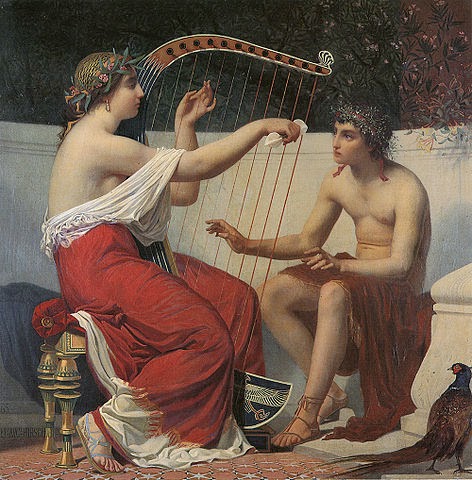
Calliope drops knowledge on Orpheus
Choose Your Muse: Calliope
Importantly, we also have the capital-C Calliope. She is The Muse of Eloquence and Epic Poetry.  With the slams that insist on coaching or curating the presenters, there is often better personal storytelling going on as well as the sets of inspired, touching, relevant and eloquent tales. Seemingly touched by Calliope herself, some of the storytellers in these slams create a wonder to hear and feel.  These Calliope[1] storytellers elicit a room-wide guttural sound of agreement or appropriate laughter from the audience immediately before they begin applauding. These good tellers are now the ones who inspire others to share their voices.

Take Some Action
Thinking that you want to be more on the Calliope side of things? Here are four actions you can take for improving your storytelling. First, get better coaching or (as a producer) offer coaching at your slams. Then, be more intentional about the stories you are telling. Also, be sure you have rehearsed your story with others who will actually give you authentic feedback.  Finally, explore some more options and educate yourself about how stories are actually crafted and created.

While the forms of both traditional and slam storytelling have their mixes of calliope and Calliope, I am happy to say that I think that more slams are evolving to the Calliope stage.

*****
[1]Or...go ahead and blow my alliteration by using the name of her son Orpheus should you need something more masculine.
Photo Cred:
calliope: By Neochichiri11 (Own work) [CC0], via Wikimedia Commons
Calliope: Alexandre-Auguste Hirsch [Public domain], via Wikimedia Commons
The is the official blog for K. Sean Buvala, storyteller and storytelling coach.

Saturday, May 14, 2011

Stories and Cocktails: "Is Storytelling Always Like....This?"

The Woman stopped the Storyteller on his way out of the main room.

"Is the storytelling always like…this?" The Woman asked, wrinkling up her face in a type of "smells bad" nose-pose and pointing to the front of the room where the Slam had just earlier finished that evening.

"What do you mean?" asked the Storyteller.

"Well, these stories don't sound like things you would hear, you know, if you were out with friends having cocktails and sharing stories. I think that is the best storytelling." she replied.

He answered, "Everybody has their favorite type of storytelling. As well, there's a big difference between telling stories on a stage in front of strangers you don't know and telling intimate stories over drinks with a few good friends."

"Like how?" inquired The Woman.

"If you are out with friends," he answered, "then you are dealing with an audience that you understand well, I hope. You might be freer with descriptions, glossing over the parts you already know that they would know and spending more time on the parts that would be of interest to them. When you tell 'cold' on a stage with a group you just don't know, you have to be more responsive to how they react and be able to make lightning-fast changes to your delivery."

"I don't see how it would make a difference," she responded, "I mean you get your story ready and then you just tell it."

The Storyteller shook his head in disagreement. "As a storyteller, I never 'get my story ready' and put it into a singular form. Every time I am with an audience, three parts of the experience are constantly changing. The storyteller, the audience and the story are involved. If I have memorized how to tell my story, then really I am just acting."

"I never thought of that," she said as the nose-pose she had been holding softened.

"In fact," added The Storyteller, "we might have seen some of that tonight. Most of the storytelling was pretty good. But, we had storytellers who are so used to telling their story 'one way' that it didn't work here tonight with a much more casual crowd and distracting atmosphere. Then, we had people telling to a room of 70 people as if we were all across a nightclub table from them, talking too fast and dropping their sentences. Too uptight or too casual are both signs that the storyteller is not reading the audience."

The Woman thought a bit as sparkles of recognition danced across her forehead. "So, a storyteller has to be able to 'go with the flow' and be ready for audiences that might be stuffy or an audience of friends who are going to be silly. It's not all the same all the time."

"Yes," he laughed, "a good storyteller is constantly adjusting their telling as they tell."

"I think I will have to learn more," replied The Woman as she shook hands with the Storyteller, waved and walked away.

"Hmm, I think we just wrote my next online post" the Storyteller thought to himself as he walked on, looking for where the rest of his car companions had gone.

****
Photo courtesy of Fotolia.com. The official blog for K. Sean Buvala, storyteller and storytelling coach.