Showing posts with label storyteller. Show all posts

Tuesday, July 03, 2018

The Selkie and Her Children


The Selkie and Her Children: A Story by Sean Buvala. 


Excerpt:

The man looked out toward the beach and there he saw a bonfire and around it were dancing the silhouettes of a woman and her children and as he looked about he saw that there was a pile next to them and so he figured that these must be selkies and that pile was their pelts. He knew that if he took their pelts away from them, they could not return to the water and that he could tell them what to do and so while they were dancing silhouetted against the flame, the man snuck up behind them, grabbed the pelts in his arms, and held them tight.

Immediately, the woman knew that their pelts had been stolen and so she turned to the man and she said, "Sir, please give us those pelts back. We must have them."

He said "No, you are on my land. This part of the land here is mine and you have trespassed upon it. No, you will do as I say."

And she said, "Sir, please, the seas from which we come are rough and dangerous for my children. We need to come here."

And he said, "No. I have told you. Here is what I am going to do. I'm going to take your children and lock them away. You will become my wife and you will do as I say."

She begged the man to return the pelts but he refused. And so, she reluctantly agreed to his terms.

He took the children and he put them in a cellar. There in the cellar, they could not hear the sound of the ocean. There was, however, a window high at the top of the cellar. When he would come back every day bring food to the children, he would open the window and leave it open for an hour. He would then close it, He would leave the cellar, lock the door behind him, leaving the children behind. He forbid the selkie woman from ever going to see the children, lest he take them away in secret to a place she would never know.

He took the pelts that he had stolen from them and he put them in a chest, keeping them under lock and key. The selkie woman, meanwhile, became his wife and, as you can imagine, she was miserable. She did not give him any children of his own. Every day, she would go to the edges of the ocean, sit upon a rock, and simply lament the loss of her sea children.

Watch the video for the entire story.  CC video.

Sunday, May 07, 2017

Take Away the "Take Away."

May I Suggest: Don't always tell people what to think about your stories.

As a Storyteller, you might need to learn to trust that the relationship between you and the audience is something that develops. First, it grows because of your ability to be open and accessible as a teller. Secondly, it grows because your audience is full of competent, life-living human beings. In all actuality, our role as storytellers is to help the audience discover for themselves their own understanding of the subject that we're talking about.

It's easy sometimes to think that when we finish telling a story, and this is especially true in telling personal stories, that we need to tell them why we have talked about the story that we just presented. It's as if we can't quite trust the audience to figure out for themselves what our story might mean in their own lives.

You know this essential truth: our stories must be appropriate for the audience that we're speaking to. If you practice this careful selection of well-crafted tales, then the audience won't struggle with the story that you told them. The time to be concerned about whether or not the audience understands why you are telling a story is in the crafting process. The time to be sure the audience understands is not at the end of telling the story, it's before you stepped on the stage.

When your story connects to world-sized Truths, there is no need for "here's the moral of the story" lecturing. Telling an audience what to think, what to "take away,"  rips the audience out of the transcendent experience of the story. It turns the teller into a preacher or teacher, not a storyteller.

Now there are times, of course, when you are telling stories in a teaching situation. In those roles, your stories will tend to be more didactic, and it's okay to walk the audience through a discussion about why you told the story the way that you told the story. And I would always encourage you to engage anyone who, after you telling, says, "Can we talk about that story?"


 However, I think that for most performance pieces, open-mic storytelling events, or personal storytelling nights, this "take away" habit that people are falling into now (explaining why they told the story) is really detrimental to the art form, to the storyteller and, I believe, to the audience.

Frankly, if you get to the end of your story and you feel you have to explain what the story is about, then you're not doing your deep work in crafting your story in the first place. It's simply too lazy to get to the end of your personal tale and then tell the audience what they should take away from your story. It falls back to, "Show, don't tell."

Let's be clear, your role as a storyteller of personal tales is to be the student of the experience you are describing. You are walking with the audience, not shoving them forward. Be ready to engage with audience members after your story, but start with what in your story resonates with them.

I'd invite you to work more intently on creating well-crafted stories so that the need to explain yourself the end of the story really is not existent. Facilitate understanding, don't preach. You'll be shocked how much you learn.

******
The is the official blog for K. Sean Buvala, storyteller and storytelling coach. My thanks to the very talented Mark Goldstein for the picture of me performing.

Sunday, April 19, 2015

Storytelling Slams: Cocktails, Canapes and Calliope

Like me, a calliope is sometimes full of hot air.
A bit of personal reflection: "Cocktails, Canapes and Calliope" is the new way that I am understanding the ongoing evolution of the Story Slam.

There's been, in my little circles, some discussion by the oral storytelling community (both online and offline) about story slams. I've been reflecting, mostly for myself, on my evolving image of the story slam.

Story slams, henceforth just called "slams," vary in style, quality, rules, and process but most are built around telling personal tales that are supposed to be true. The sharing of personal stories has probably already existed since people learned to speak. Really, aren't slams just the extension of gossiping with your neighbor over the backyard fence in olden times, like 1970 or some such date? Slams, if nothing else, create self-selected communities when we are too busy to know the people who actually live in the homes next to us.  If you need to know more about slams, I've written about them here and here and always-teaching here.

In the most popular cases, these storytelling events usually are almost always held with food and drink (hence, "cocktails and canapes") for the audience. It seems, from my experience, that the best-attended slam events have these two elements. I'm wondering if this is unique to this version of storytelling (as a performing art) as I can't imagine that most folks go the ballet with a table of highballs and mixed nuts.

New Words
Lately, I am seeing some positive shift in the quality of these events.  I know that "quality" is subjective and personal, as for some people every word uttered on the slam stage should be applauded while others shun the entire reality of slams. However, balance is important.

I used to describe slams as "karaoke storytelling".  "Karaoke" was once the cocktails-and-canapes version of "everybody's-a-performer" event before slams started to take over. For many of the events I saw at the beginning of the story-slam trend (1998?), "Karaoke storytelling" was the right description in my mind. People readily understood the model: get up and talk (usually in anecdotes and not really in stories) about one of the big-three subjects of sex, drinking or nakedness (with a smattering of  "how crazy my family is") and you could get an ovation. Much like karaoke singing an off key-version of "Midnight Train to Georgia," you would at least get applause for your efforts and (important) your telling would embolden others to share their voices.

However, in the last year or so, I am seeing a positive shift in the quality storytelling at some slams. I'm replacing my use of the word "karaoke" with "calliope/Calliope."

first, it's a calliope
Let's start with the calliope with the small-c. A calliope is a loud, offkey, hot-air driven musical device that is used at circuses and state fairs. It's blustery, attention-seeking and, for a few moments, can be fun to watch. They are a novelty for music; they are not something I want to listen to all the time. Sadly, there is still some calliope-style storytelling going on at slams. While you can get a "ringer" who truly understands how to tell a story, there are still some storytellers who are new and loud. Worse yet is the storyteller who is not new, just lazy (untaught?) in story-crafting. This happens often in "draw the contestants' names from a hat" shows. These are the calliope storytellers. You will have some fun, but you will get tired of listening to these tellers after a while. There is much noise and distraction coming from these calliope tellers.  In fairness, we could say that there is some serious butchering of world-tale story in the traditional presentations, too.

Choose Your Muse.
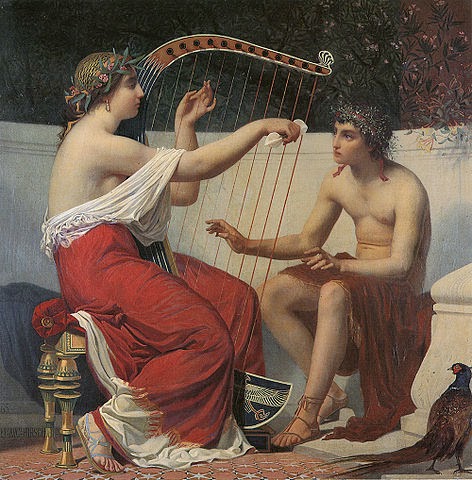
Calliope drops knowledge on Orpheus
Choose Your Muse: Calliope
Importantly, we also have the capital-C Calliope. She is The Muse of Eloquence and Epic Poetry.  With the slams that insist on coaching or curating the presenters, there is often better personal storytelling going on as well as the sets of inspired, touching, relevant and eloquent tales. Seemingly touched by Calliope herself, some of the storytellers in these slams create a wonder to hear and feel.  These Calliope[1] storytellers elicit a room-wide guttural sound of agreement or appropriate laughter from the audience immediately before they begin applauding. These good tellers are now the ones who inspire others to share their voices.

Take Some Action
Thinking that you want to be more on the Calliope side of things? Here are four actions you can take for improving your storytelling. First, get better coaching or (as a producer) offer coaching at your slams. Then, be more intentional about the stories you are telling. Also, be sure you have rehearsed your story with others who will actually give you authentic feedback.  Finally, explore some more options and educate yourself about how stories are actually crafted and created.

While the forms of both traditional and slam storytelling have their mixes of calliope and Calliope, I am happy to say that I think that more slams are evolving to the Calliope stage.

*****
[1]Or...go ahead and blow my alliteration by using the name of her son Orpheus should you need something more masculine.
Photo Cred:
calliope: By Neochichiri11 (Own work) [CC0], via Wikimedia Commons
Calliope: Alexandre-Auguste Hirsch [Public domain], via Wikimedia Commons
The is the official blog for K. Sean Buvala, storyteller and storytelling coach.

Wednesday, April 08, 2015

Storytelling Practitioner: What Does 'Show, Don't Tell' Mean?

Storytellers use too many words...sometimes.

In this next "Hard-Core Storytelling Practitioner" post, I am talking the concept of "Show, Don't Tell" (written as Show or Tell in this article) that is prevalent in the "sacred" texts (giggle) of many who practice oral storytelling.

Background
This is all Show. You would need some
Tell to understand this pic, huh?
I've been noticing lately in the audio recordings of our storytelling events that some of my stories might seem to be "missing" parts when listened to. However, I am not too concerned since the parts that are missing are the parts that I am "Showing" the audience the story rather than "Telling" the audience the story.

Adding to my reflection this week came Cassandra Cushing, who serendipitously asked on Twitter, "Storytellers, what does 'show, don't tell' mean to you? Do you like this phrase/concept?"

You can see most of the friendly conversation between Cassie, Tim Ereneta and me in this link here. In the debate for meaning and its application for oral storytelling, the "Tell" part of the phrase is easy: Words. Storytellers use words intentionally, judiciously and musically. But, don't use too many words, Show some words instead. Use too many words and, like extra salt in a soup, the experience of storytelling is spoiled. With not enough words, the story can feel flat just as soup would be when lacking salt.

So, for me, the question comes down to this: what does "Show" mean?

My Understanding
In the debate for meaning of "show, don't tell" and its application for oral storytelling, the "Tell" part of the phrase is easy for me: Words. Storytellers use words intentionally, judiciously and musically. They also need to do so in front of a live (present with them) audience. Because of that unique requirement of audience presence, the storyteller is free to Show the story through simple gesture and characterization.

I have a choice. I can Tell you a description of every character and how they are reacting to the world around them or I can Show how they are feeling and reacting in their story world.

Use too many words and, like excess salt in a soup, the experience of storytelling is spoiled. With not enough words, the story can feel flat just as soup would be when lacking salt. Tell the story, give enough narrative, walk with the audience towards the full realization of the story you are Telling. Use Show much more liberally. Watch your audience as you are storytelling, trust them to "get it." If they don't, maybe they need more salt in their soup?

Let's look at one character in one story, as an example of Show. When I tell one of the original Grimm versions of "Cinderella," the step-mother is clearly unhappy with Cinderella's ability to outsmart her. As she speaks in my story, demanding even more dried peas be picked from the ashes, I see her in my mind's eye. I Show that to my audience: my body straightens, her speech becomes clipped and she does the "plastic smile" at Cinderella. Her gestures become staccato and she unconsciously picks at her fingers, rubbing thumb to side of finger as she holds one hand in front of her. I am Showing the character to the audience. Step-mom's persona lives in me in these subtle ways.

Each character has their own "way of being" that is Shown in my way of bringing the character to life. This is so much a part of my telling that, in order to write this for you, I had to briefly tell the story to myself, so that I could remember the nuances of the character. I had to figure out how to tell you all those words to describe Step-mom in this article. Whew! Thank goodness I don't do that for actually storytelling.

Some Ways to Show
As a storyteller, you have a full pallet of ways to Show a character. You will be using hand gestures, facial expressions, gaze, and body posture and body position. Your tone of voice might change between characters. You will be being giving attention to your pacing, pauses and your eye contact. Incorporate the character into your being, Show the characters to your audience.

Exceptions
I am aware that for some audiences that may be visually challenged you may need to add more words to your story, using Tell more liberally. Also, for audience members on the Autism spectrum or others who have trouble with interpreting social cues, a more direct approach to "The Step-mom was angry, trying to control her voice…she sounded like this," might be a better choice. As storytellers, we always put our audience first. What do they need?

 But what about oral recordings?
These concepts of Show and/or Tell have different rules in a recording, particularly in an audio recording such as a CD, mp3, radio or podcast. Storytelling performances recorded in audio (or video) are not storytelling. They are records of a storytelling event, no matter how entertaining they may be. For example, my current version of the Rumpelstiltskin tale is of a tiny man of few words, but with a very expressive face, head gestures and lingering eye contact. That Showing simply does not translate well to an audio recording. To record it formally, I would have to change the balance and techniques of Show and Tell.

A story designed for recordings (audio) is closer to "voiceover" than storytelling.

Tl;dr or My Conclusion
Here is what I am practicing and using these days: Showing and Telling are both important parts of oral storytelling. Showing in a story is the whole body, subtle and nuanced, expression of a character or place in live storytelling. Telling is where the narrative takes over the story or the characters speaking things that move the narrative forward. I prefer that storytellers; Show me nuances of the character.

Edit April 10: Cassie Cushing has posted more on this subject on her blog linked here. 

******
The is the official blog for K. Sean Buvala, storyteller and storytelling coach. Photo Credit: Library of Congress, Prints & Photographs Division.

Monday, January 12, 2015

The Journeyman Storyteller: Ready for the Next Step?


Journeyman 1: The Oral Storytelling Realities

I've written a post that has a very specific audience: for those that are making some part of their livelihood as a working artist. Since it is more "insider" than other posts on this blog, I have published the entire article over at http://artistmarketingworkshop.com/storytelling-journeyman-ready/

Here is an excerpt from the long article. Please come take a look if it is of interest to you. Thanks. 

"There is a space in the arc of the careers of all performing artists where one transitions from wide-eyed beginner to being an effective, talented Master.  In between those two stages is the important step of Journeyman. . .


This article is very specific to the oral-storytelling journeyman. You have passed through those first apprentice-based stages, taken some of the good myths and standards of the art. Now you are stepping up into the day-to-day realities of making some of your income as an artist.


Here are a few of the myths (both implicitly and explicitly taught) that many next-level storytelling artists have found they have to work through:


1. Everyone is a storyteller!


2. Stories choose the storyteller.


3. Your storytelling should always make you feel good about yourself.


4. Do what you love and the money will follow.


5. If only X would happen, then I would be successful!


Finally. . .

As I write about these five very popular myths, I am more aware of one thing. . ."

I've also recorded this post as an audio file. Visit the page linked above to hear it. 


******
The is the official blog for K. Sean Buvala, storyteller and storytelling coach.

Saturday, October 04, 2014

Ringmaster Not Roustabout: Those Basic Basics in the Storytelling Tent.

 circus clown ringmaster speaks with youWhy, hello there, storytelling newbie. I didn't see you standing there. I've been so busy lately over on other shows that I haven't had near enough time to speak to you.

Nonetheless- do you have a moment? Oh, very good.

Welcome to the show. And what a show it is. Storytelling is the mother of all art forms. An idea forms from the substance around us. That form then becomes narrative. That narrative becomes story. People share those narratives together and the story becomes storytelling. That storytelling inspires artists of all types.

Since you have walked into the Oral-Storytelling tent with the rest of us, let me welcome you inside with a few tips.

1. Use a microphone. If we can't hear you, your story has no value to us. Sitting with friends and entertaining them with your story is one thing but if you are going to stand up and speak to all of us: we need to hear you, no matter how confident or pumped you think you are.

2. Stay focused on the story. Some people will tell you that a storyteller is supposed to just be a vessel for the story, but that's pretty much metaphorical talk that is far away from where you are now in the art form. But here's a problem: that cool thing you do with the broad acrobatics and grunting (or guitaring or balancing plates on your head…whatever) isn't helping with the story. If at the end of an experience of oral storytelling we're talking more about your antics than the story you told, then something went wrong with your storytelling.

Let me clarify that I am not in the be-still-all-times storytelling camp. Your intentional movements that keep the story clear are just fine. Keep first in your mind your story and the connection it creates to and with your audience. Be ringmaster not roustabout.

3. Learn your story in parts. I see new storytellers try to recite stories they have memorized. They get lost and confused. So, do storytelling instead. See the story. Break it into parts. Tell us the parts you see rather than the words you have stored. Cool phrases and "crafting" (you are going to hear that word a lot) of the story will come later as you internalize the story. For now, go unplugged-style and just tell us the story you are seeing.

4. Get coached. If you are going to be serious in any art form, you need to take some classes and get some input. Tell me, how many sports stars are self-taught? None of course. You can be sure that every other artist in this tent (regardless of their skill level) has voices they seek out for guidance.  If you are telling jokes in the bar (not storytelling anyway), then you can go it alone. If you want to communicate, you need training and coaching.

So, I am glad you are here. We need new voices and new understandings of our very specific art form. Come grow with us who have been at this for a while. I love it when I get to say, "I learned something from this new voice today." That is so cool.


******
The is the official blog for K. Sean Buvala, storyteller and storytelling coach.

Wednesday, January 01, 2014

Getting the New Year in Focus

Heads up: this post is a bit more personal than what I normally post here. I'm writing more about the "artist" than the "art."

You might be tired of the New Year's posts, but I just wanted to share a thought that was new to me. It's not an idea that I thought up as I first heard it in a workshop from Trish Gillam at Gangplank Avondale. I've seen a mention or two since then in other places.

I'm not a fan of resolutions, even if I have written about them in the past. I find that people either "do" or "do not do" projects and ideas in their lives. However, I do like the idea of having a "theme word" for a year. As professional performing artists, I know it's easy for all artists to see grand possibilities about the future but forget that such possibilities need a firm foundation.

Now, my  2014 "theme word" is "organized." I let too much of 2013 get past me, for many legitimate reasons. At other times, I allowed myself to be overwhelmed by ideas and goals and then, in that mess of possibilities, I ended up not making anything happen.

This is not to say that 2013 did not have some good projects and surprises. 2013 did indeed have some unexpected-yet-good events. However, in being honest, I found that I lost momentum by not keeping a better reign on the structures of my work and art. In that, this was a rare year for me.

So, in this year as an artist, coach and family man, I will ask myself a question about the projects I choose and the activities I do: "Will this help me be organized?" An organized (not compulsive) working artist can achieve many goals and get projects done. This is not solely about being "neat" or "housekeeping;" rather it's about being together in mind and purpose.

My word for 2014 is "organized." No lofty resolutions in that one word but rather a need to see the top of my desk again, the transcendent side of my work as an artist expanding, books and projects completed, my calendar better filled with bookings, and my family still moving forward. There is no order to that list as I see it as an overall way of being rather than a list of  resolutions.

I hope this makes sense for you as a fellow artist or entrepreneur. If you chose a word that would describe your goals for 2014 what would your word be?

******
The is the official blog for K. Sean Buvala, storyteller and storytelling coach.

Saturday, October 12, 2013

Storytelling Practitioner: How to Use Stories in a Short Presentation

On Friday I had a follow-up coaching session with a student from one of our Executive Speaking Training Workshops (EST). In these follow-up sessions, I often work with workshop students directly in creating their presentations. The private session is part of the package of the EST registration.

As part of my recent binge of hard-core storytelling-practitioner blog posts, I thought I might share a white-board illustration with you that I created while my client and I were working. She found it useful. I did not intend to use this drawing as a blog post, so you are getting a raw piece of my mind here. Be gentle with any comments about my scribbling drawing skills.


how to tell a story in a presentation illustration
The scribbles in the middle read "facts."


My student, who works in inventory control in a large international business, was trying to create a 10-15 minute presentation. I showed her a model that I sometimes use in my own public speaking. It uses either two or three stories to "bookend" or support factual content.

As you can see from the drawing, I suggest that stories serve two purposes in a short presentation. They are the first high points that bring the energy of a presentation back up. They also serve as frames (or hooks or nets- however you want to read it) for the presentation of facts during her discussion. There is a typical ebb/flow level of energy in presentations as you can see in this white-board picture.

There can be either 2 or 3 short stories in this presentation model. The first "bookend" flow (as drawn on the board) uses two stories and is seen as:

 Story A - Fact Set 1 - Story B- Fact Set 2 - Story A.

This second appearance of Story A is either the same type of additional illustration from Story A or a reminder from a lesson suggested in Story A. So, in a perfect white-board illustration I might have written A1 and A2.

Another way to do this presentation is to have a Story C at the end of the presentation that ties together the other stories and facts. I have noted that in the picture with some after-the-fact text added to the drawing.

Story A - Fact Set 1 - Story B- Fact Set 2- Story C

Of course, you will add your own introductory and closing comments, but for our meeting, we didn't need to write these on the board.

Other thoughts: I assume that you already understand that the stories would be connected to the content presented in the facts, perhaps to illustrate the reward or consequences of paying attention to the facts in the two sets. Also, the stories could be a mix of "real life" stories and a world-tale. One story, especially Story B, might be more of an anecdote and not a full story. It depends on your skill and your situation.

This is a good model for a short 10-15 minutes speech. You would adjust the process based on the time you have to speak. I have written about some other presentation models in the past as well.

I hope this is helpful.


******
The is the official blog for K. Sean Buvala, storyteller and storytelling coach. Written right out of our offices at Gangplank Avondale.

Monday, September 16, 2013

Storytelling Practitioner: How Does Pacing Work in Oral Storytelling?

I am spending some more time in the hard-core storytelling practitioner mode. My next thought: There are two ways to describe the pacing of your story.

First, pacing refers to how fast your story unfolds. Do you spend more time on some parts of the story and less time on other parts?  You may want to spend more time on one episode, piece or interaction in your story than another. Your audience will help you determine this. Although you may be telling the same story, the differences in your audience will help you to know when to focus more on part A or part B.

For example, when I tell my version of the "Fisherman and His Wife" to children, I will spend more time on the "funny" parts of the tale such as the fisherman and the fish speak to each other as well as the characteristics of how the wife reacts to each new change. When I tell the story to adult audiences, I will spend more time with the relationship between the fisherman and his wife. Since my stories are in episodes rather than a script, it is easy for me to change the pace at which each segment is revealed.

There is a second way to describe pacing in storytelling.  How fast you speak while telling the story? Mastering intentional pacing can help you create nuances in your story.

When you speak with a slower pace, you might be conveying the ideas of fear, anger, disbelief, astonishment, or awe.

When you speak very quickly you may also be sharing the emotions of fear, anger, excitement, energy, joy, surprise.

You will notice that I listed the words fear and anger for both slow and quick pacing.  Think about the following questions. What (or WHO) makes the difference in how those emotions are conveyed? Does it make a difference in who is being addressed? Does it make a difference in where the action is taking place?

Overall, most new tellers don't think about the ideas of pacing. They simply tell their story, with their pacing based on whether they are having trouble remembering the episodes (slow pacing) or just trying to get all the words out of their brain (fast pacing).

 Rather than just let your words fall randomly from your mouth, make intentional choices about how fast your characters speak


******
Sean Buvala is a storytelling coach and practitioner. He's the creator of the Storytelling 101 Elearning kit.

Monday, September 02, 2013

Storytelling: The Original Social Media (Tshirt Edition)

Isn't this the truth? The first true way to gather community was (and is) storytelling. Social interactions, education, training, passing on values and more come from the "social media" of stories and storytelling. We are just having some fun with a few Tshirt designs. Here's the first in the series. You can pick up this version until September 9, 2013. After that, you can sign up for the update list when new shirts in the series get released.
Store link is:  http://storytip.net/storymediashirt


******
The is the official blog for K. Sean Buvala, storyteller and storytelling coach.

Friday, May 27, 2011

The Mythology of Business Storytelling, Part One.

The backlash against any business fad begins slowly. Hype buries the good ideas that are contained within a business movement. For example, when people discover that you can't manage people in just one minute or that there really isn't much fun in throwing stuffed toy fish around the office, the genuine value (read that "the work") of a concept gets abandoned with trappings and hype.

Storytelling and other forms of story expression can work well in business and non-profit organizations. I have seen this played out repeatedly since I began this journey of coaching and training back in 1985.

Of late, I am seeing the rumbling of hype-backlash in the discussion, teaching and preaching of business storytelling. Here are the first three types of buildup of which I think we all need to be aware. I will take on more in the next post. I have gathered these myths from personal experience, social media, blog posts and email.

By the way, "a myth" does not mean "a lie." Myth is truth covered in an agenda.

Myth 1: Storytelling is instant corporate relief.
In tough economic times, everyone is looking for that quick fix to make business work or to grow donations to a non-profit group. The challenge with story, and especially delivery via storytelling, is that it actually takes real work to develop. It takes training to do it well. When you look at how storytelling is being discussed today, do you often see a discussion about the amount of focused work it requires?

Is there a return on investment (ROI) when using storytelling? Yes, there is, but it comes slowly and requires a long-term commitment. (I have written before about what storytelling won't do for a business.) A one-off dive into story work is represented via such slogans as "This year, our company training focus is 'Storytelling!'" Short-term investment reduces the authentic stories of your real customers and employees to gimmicks. Gimmicks have no genuine ROI.

Myth 2. "You must believe in your story."
I have seen variations of this on Social Media more than once, with the emphasis on the word "believe" as an otherworldly transcendence into the metaphysical. Your IT and accounting departments are most likely filled with people who are not going to buy this whole "storytelling" thing. Throw in some Matrix-movie-like dream-world discussion and you will lose both departments. You do not have to believe in metaphor or transcendence in order for a corporate story to be effective.

Your corporate stories must be true and sincere, but they do not have to be magical. Storytelling, done well, creates "deep listening." Many people think that deep listening must be magical. The reality is that in our instant-everything and low-imagination world, we have forgotten that people used to listen like that all the time.

By the way, I do understand the attraction. It sounds like fun to tell stories instead of doing marketing or selling! It is fun to talk about the transcendent nature of storytelling and the stories used within storytelling- but do not make acquiescence to those ideals as a requirement for corporate storytelling. I do not understand 25% of what my technology-guru brother is talking about in regards to computers, but I sure know how to use this word-processing program.

Myth 3. "Storytelling in business is a different type of storytelling."
Like all myth, this has truth at its core. The truth is that every time you speak to a different audience, the experience of the story you are telling changes, even if the teller and the story are the same. I can tell the same story to an audience of entrepreneurs and an audience of 12-year-olds and the experience will change.

Where this myth is false is not understanding the "mechanics" of all storytelling. All storytelling uses the same skills, such characterization, pacing, crafting and gestures. For example, while my characterizations in a story for 12-year-olds might be much broader than the same story told for business leaders, characterization still is used. Knowing how and when to use gestures is as important in a presentation to your nonprofit supporters as it is to "Mother Goose Story Time" in the public library.

Finally, all business stories must be properly crafted in order to be impactful on the listener. It is not enough to just want to use story and storytelling- you must spend the time to construct the story. That crafting process is the same for any setting.

Remember, not every conversation you have should be labeled as storytelling. Sometimes small talk is just small talk. Sometimes a call to customer service is just a phone call, not an epic journey.

I am already at what looks to be the world's longest blog post. I will post part two sometime over the weekend.

PS. I have been asked, "Sean, who died and left you in charge of storytelling?" All I am opining on is what I see from my unique vantage point of experience and practiced approach both on and offline. I could be wrong about all this. Do not believe everything you read on the Internet.

Or, I could be right.

(Read Part Two at this link now.)
***
The is official blog for K. Sean Buvala, storyteller and storytelling coach. Illustration in this blog comes from www.gapingvoid.com and is used under the Creative Commons license. See Sean's storytelling training workbook at www.storytelling101.com

Tuesday, June 17, 2008

Every Business Needs the Power of Storytelling

“But I don’t need corporate storytelling, it has nothing to do with my work.”

I was in a city across the country from me and I was teaching the corporate storytelling version of my “Storytelling 101" presentation for a large company. The training had been designated as a “not mandatory but we want you to be there” event, so some people came to the meeting just a bit hostile.

During the break, I was, umm, sitting in the bathroom and behind a closed door. That’s all I will say about that. Just know that those who came in could not see me. Two other men entered the bathroom and as they washed their hands, they began to talk about how “stupid” it was for them to be there at storytelling training. “What do I need corporate storytelling for?” the first man asked the other and continued with other gripes.

I stepped out of the place I was sitting which I think shocked the first guy. Perhaps surprised to see me and a bit embarrassed about griping about the speaker behind his back, the first man then started in on me about “what could a storyteller teach me?”

Washing my hands, I asked him, “So, what do you do here?”

He then went on to explain that he directed the process where the company secured new buildings. He told me about how they have to help the decision makers understand how the building will be used, not just how much it costs. He then told me about one particular building they acquired that was now used to help families work through long-term illness saying, “What a difference it makes in the lives of people.” The pride of his work was clearly reflected in his conversation.

I said, “You know, that was a great story you just told me.”

He stopped, took a long look into the mirror and sighed. He knew I had caught him in the proof that every area of every business uses storytelling. He knew that he had just used storytelling to tell me about his work.

This executive looked right at me, mumbled, “Oh, (censored)” and walked out the door.
My new corporate friend was very attentive the rest of the training session.


No matter what your company is about, I would be honored to train you and your staff in the power of corporate storytelling. Please let me know how I can help you.

The official blog for K. Sean Buvala, storyteller and storytelling coach.

Saturday, May 03, 2008

Small is the New Big

In a quick response to Tim's latest blog post:

Tim, with respect for you, I disagree. I really want to agree. I really want to believe change is on the horizon. But, it’s not.

To be even more honest, my compassion is fatigued. I’m still waiting for that apology call from the BOD after the Eric Miller fiasco. Did you get your call yet? I know, it is never going to happen. And really, does anyone believe the ED resigned of her own accord? If that is true, then we really do lack leadership.

Tim, It’s not a battleship, in my opinion. That is too modern a reference. Rather, it is an old-timey, rusted bicycle that has been given a new coat of paint, right over the rust. Then, they added one of them new-fangled battery powered lights to the front. “See how pretty it is, children?” There is nothing new here, with the exception of the location change. This is not even the first time an online forum has been tried and failed for the NSN. What is going on?

The Marketplace solution is already in reach, has been for years with the clear knowledge of the last two Chairs, with zero out of pocket expense from the BOD. Don’t see that happening, do we? Saying collaboration is desired is smoke screen, as I have experienced it.

Now, instead of taking the money that is already on the table, we’re supposed to do benefit concerts for the NSN? Sigh.

The solutions for the NSN are:

1. Allow it to die and resurrect Phoenix-like with a new mission, a new look, a new name, new energy. Nothing says “we mean to change” like letting something, well, change.

2. The new organization must work with existing organizations in true collaboration, reaching out to heal the many wounded that have been left in the wake of the NSN’s path over the last few years. The current economy also demands collaboration.

3. The new organization must be de-centralized. Set Godin calls it, “Small is the New Big.” Regional offices in Chicago, Boston, Phoenix the current office in Tennessee (for example) will allow for a fast moving, modern organization that can reclaim the “Mother of All Art Forms” mantle that storytelling should have. The new ED can then choose to work out of any of those offices. How powerful an incentive that will be!

4. If there is not going to be a resurrection, then there needs to be competition. That will be an economic hit, too. However, right now, you can have your national storytelling in any flavor you want as long as it’s 1970 Julep. Maybe, ultimately, that is the problem.

It's time for me to just stop talking about this. Your mileage may vary. Shoot the messenger. Not valid where prohibited by law. I may be wrong. User assumes all risks.

The official blog for K. Sean Buvala, storyteller and storytelling coach.

Saturday, April 19, 2008

Story. Interruption. Storinterrupry. Interrustoryption.

Is some of this ADD we're seeing our fault?

The more I work as a performing artist in schools, the more I think we (the adults aka the system) are somewhat to blame for this ADD (attention deficit disorder) epidemic.

There are exceptions, but during the last year as a storyteller, I've noticed the following are rather standard at every school in which I have performed or done a residency:

...Classrooms placed next to the choir and orchestra rooms- with that constant noise coming in and out of classes that are not music classes.

...Adults who use whistles a bit too much.

...Adults who, while I am performing, walk right in front of me as I am speaking.

...Bells, tones, chimes going off continuously during sessions.

...Unplanned, verbal, over-the-speakers announcements given in the middle of sessions.

...Militaristic guarding of who can and can not walk around, near, through or about locations, doors, and sidewalks. Cafeterias are guard-dog-like guarded from who may and may not step into those spaces.

...Cavernous Cafeterias/Gyms, poorly designed for sound, being used for school presentations, with echoes and reverb so bad I had to move parts of the shows.

...Children, lots and lots of children, being called out of presentations to go to yet another piece while the first piece they are watching is ongoing.

...Story interruption story interruption storyinterrupstory stinterrutory storyinterstoy storyinterstory story interrupstory interruption. story. bell.

...Adolescent students slamming energy drinks as if they are drinking bottles of water.

...Computer tech people talking on phones while performances are going on.

...Teachers who talk, in small groups in the middle of the audience, the entire time the children are watching the performance. Woe to the presenter who dares correct these teachers, too.

...Adults who yell at entire assemblies of children for not being quiet right after the presenter asks them to participate.

...Corn-syrup laden treats given to children as "after school" snacks.
I enjoy doing the school shows. In being honest, however, the distractions are so bad in some cases that I have trouble concentrating with my own version of ADD and Fog. How do we expect children to survive this? If our corporate offices ran like this, there would be meetings about efficiency and solving the "noise crisis."

I understand that teachers are, usually, doing the best they can in these situations. And I know that ADD, in some cases, is biological. It will be interesting to see how many people leave me flaming comments before they even read this last paragraph. I'll get to rest my case then.

The official blog for K. Sean Buvala, storyteller and storytelling coach.

Monday, February 18, 2008

The Price

One of the guru guys I have followed says, "The Price of Clarity is the Risk of Offense."

Lovers of our art, we can't keep talking without saying anything. It's okay if you don't do what I do. Do what you do. That's what I want for us to do. But, gosh, say *something* about what you do. Pablum is for infants, not storytellers. Take a risk. Sign your name. Have an opinion. Or wave to the folks as they watch you in the rear-view mirror.


I care about you and yours. Really.


The official blog for K. Sean Buvala, storyteller and storytelling coach.

Sunday, February 17, 2008

RoadBlock #10: Too Many Personal Stories

In a previous posting, I made a list of ten “Roadblocks to Your Success” for the professional storyteller. With this article, I am starting to explore those statements more in depth.

I wrote that number ten was: “Especially for U.S. and Canadian tellers, you are telling too many disconnected and without-context personal stories.”

I believe that when we say “storyteller,” the general public usually thinks of either a children’s entertainer or a stand-up comedian.

So, what does the average stand-up comedian do? They tell stories about the people they know, the situations they have been in. Most of them are funny, some of them a little touching. A comedian interacts with the audience, without the fourth wall, talking right to them and sometimes using what the audience says as part of the things the comedian says on stage. Sometimes they use “naughty words” that offend anyone over 21 but those words are part of the culture the comedian comes from and it is to that culture they want to speak. Maybe when the comedian uses those words, someone from outside that culture will gain knowledge about another way of thinking.

Storytellers are quick to point out that we’re not stand-up comedians.

So, what does the average storyteller do? They tell stories about the people they know, the situations they have been in. Most of them are funny, some of them a little touching. A storyteller interacts with the audience, without the fourth wall, talking right to them and sometimes using what the audience says as part of the things the storyteller says on stage. Sometimes they make cultural references that are lost on anyone under 21 but those references are part of the culture the teller comes from and it is to that culture they want to speak. Maybe when the storyteller uses those references, someone from outside that culture will gain knowledge about another way of thinking.

Oops. Perhaps those two careers are not so different. When I speak in some “Storytelling 101" classes at community colleges, every student in those rooms want to be a comedian, so they take the storyteller class. They hope I can teach them how to “make it” as a comedian. Why? For them, the choice between storyteller and comedian is this: one pays better than the other and will get you famous while the other will give you warm fuzzy feelings and get you booked at birthday parties for children. We have so much work to do in educating people about our craft. To do so, we must be categorically different than other performing arts. At the moment, we are not.

What’s wrong with telling personal tales?

In the U.S. in particular, too many professional storytellers are telling too many personal tales and further blurring the line between our art form and the work of comedians. If storytelling continues on this path of telling personal tales over the classic tales of myth, legend, tall tale and fairy tales (aka world tales), we are going to see our art form continue to slide off the radar. If storytelling and comedy were to arm wrestle right now, they would appear evenly matched to the storytelling community. But, an audience-centered art form is not about what we want or what we see. Due to the way the world moves, comedy is going to win that arm-wrestling match and be the most-listened to voice while deep, rich world-tale storytelling will go and join the broom makers at the “Old Tyme Country Renaissance Faire.”

Why the over abundance of personal tales? From my couple of decades experience, I see several reasons:

First, some storytellers are fearful or just don’t want to work hard on their stories. Perhaps they are simply uneducated in how to adapt a world tale. So, they are abandoning classic world tales because they are afraid of violating someone else’s copyright. And so they should be wary. But, if you are doing the work of storytelling and building your own versions of world tales, then you have nothing be worried about. Are you doing the work of storytelling or are you echoing the style and choices of storytellers you have seen?

Second, personal tales do take some work to dredge up but overall are easy to tell. I know this will cause some to sputter, but personal stories are easier to tell as the audience has no benchmark against your experiences. If you tell “Beauty and the Beast,” that will elicit comparisons to other versions. That is scary for some tellers. However, who can benchmark your story of “Uncle Ted and the Big Green Snake?” I think the proliferation of storytellers who have invented family members and stories who then use them as the basis for their presentations speaks to the general ease of developing personal tales and the ease of telling them to modern audiences.

Third, some storytellers are seeking therapy in telling personal tales. I’ve been in discussions where storytellers talk about “clearing out their emotions” through personal tales. Sounds great for therapy or for support groups and visits to your shrink, but it’s wrong to do that to your general audiences or otherwise force support-group status on the unsuspecting.

Should we tell personal tales?

Yes, we should. There is a place for personal tales. An occasional tale in the midst of other world tales is a good break and can create an affinity between audience and teller.
It is also possible to interweave personal and world tales in the same telling. This creates the same stand-up sense that audiences flock to but also gives the audience an exposure to the greater gifts of the story and storyteller. Some personal tales are for used for historical purposes and education. Again another valid use in the correct setting. What better way is there to teach the culture of the “old southwest” than a family story passed down from storyteller to audience?


So, I suggest the following for the working storyteller:

Research, learn to tell and use at least one world tale for every personal tale you develop.

Tell your world tales to an audience that is not composed of children locked into a school classroom, a public library or to an audience of just your storytelling groupies. So, find some 19-30 year olds and start telling.

Develop one interlocking world tale and personal story and tell those stories as a singular experience. I am not talking here about framing: “My Uncle Ted once was bitten by a snake so that is why I am telling you now about the story of the Snake Leaves.” Go beyond framing and interweave the stories. You’ll learn more about both stories in the process.


The official blog for K. Sean Buvala, storyteller and storytelling coach.

Sunday, January 06, 2008

The Purpose of the Artist

The Purpose of the Artist:

that place between what is
and what is not

between prosaic
and prose

between being responsible
and being authentic

that's the purpose of the artist

from there and from their
we fill the niches


-sean buvala

Friday, January 04, 2008

Storyteller.net Podcast for January 2008

It's a brand new Podcast at Storyteller.net! You can use the link below to hear our latest. Features storyteller K. Sean Buvala telling the Grimm tale of "The Willful Child" as well as providing a coaching moment on "finding your niche". The coaching moment comes from an interview that Sean did with the "Art of Storytelling With Children" podcast. Also on this January 2008 podcast is Kindra McGrane of Arizona telling her lively, fun personal tale of "The Bargain Shopper" recorded live at one of our http://www.storytellingatborders.com/ events. Come and enjoy. Find all our past podcasts at this link now.

Use this link to hear the January 2008 podcast now in mp3.

The "Outside In Storytelling" Model


The "Outside In Storytelling" model and approach, developed by K. Sean Buvala, is based upon one of the unique qualities of storytelling, that is, storytelling is an audience-centered art form unlike any other. To use storytelling in any modern public presentation, the needs of the audience must be the primary focus for the storyteller. For the publically presenting storyteller, there are three areas of focus that must be balanced around this outside reality of the needs of the audience. These three areas are: artistic excellence, technical (stage/performing) excellence, and business excellence. Business excellence does not always mean a direct money-paid environment. One can be a teller in a library, for example, who has storytelling as an adjunct to their primary occupation and still require the business excellence subskill of ethical behavior.

When any single portion of the model is removed, the entire storytelling experience collapses on itself. When any two areas receive more focus than the third area, shadow corners develop in the work and mind of the storyteller. These shadow areas are opportunism, narcissism and irrelevance.

For example, a storyteller who may be deeply moved by their own story and presents themselves as a purveyor of that story to an audience yet does not master a strong, understandable technique of telling the story is engaging in the shadow corner of narcissism. In this corner, artistic integrity overrides the need of the audience to see an effectively presented story. "You must pay me (listen to me) for my story because I am an 'artiste' who understands things you can not."

We have so much more coming in this discussion. We hope you come along for the ride and maybe even take the wheel for a bit.

The "Outside In Storytelling" process, presentations, development and visual model are copyright 2007, 2008 by K. Sean Buvala. All Rights Reserved. Do not duplicate this work without permission.