Showing posts with label storytelling. Show all posts

Monday, June 29, 2020

Float. Reinvent. Pivot.


Folklore is filled with stories of people who come to a fork in the road, often met by mysterious and maybe dangerous creatures.

As you move forward in the world still firmly held in the grip of a pandemic, you've got some choices.

Float.


"I hope that everything goes back to normal." That is probably not going to be in our future. The wisdom stories of the world tell us that this rarely happens once we encounter a monster. You can hover and try to wait out the storm.

Reinvent.


Perhaps what you have been doing all along is never coming back. There are pain and grief in that, but also a great opportunity. In the "way things are," are you excited about seeing new ways to serve customers and interact with your brand, even if you don't yet know what those ways are?

Pivot.


We are moving to a virtual world where brick-and-mortar and direct services might not be the right choice. Is there a new way to still deliver your product or service? You customer will still love you, and you will find new ones, too.

Are you at a crossroads or fork, blocked by a creature of doubt and fog? Look that beast in the eye and, rather than running scared, address it and ask, "What is your lesson for me today?"

***

Sean Buvala helps entrepreneurs and business owners find, craft, and share their seven unique stories to grow their businesses during these "what if" times. Visit morethanspeaking.com to schedule a call.

Tuesday, July 03, 2018

The Selkie and Her Children


The Selkie and Her Children: A Story by Sean Buvala. 


Excerpt:

The man looked out toward the beach and there he saw a bonfire and around it were dancing the silhouettes of a woman and her children and as he looked about he saw that there was a pile next to them and so he figured that these must be selkies and that pile was their pelts. He knew that if he took their pelts away from them, they could not return to the water and that he could tell them what to do and so while they were dancing silhouetted against the flame, the man snuck up behind them, grabbed the pelts in his arms, and held them tight.

Immediately, the woman knew that their pelts had been stolen and so she turned to the man and she said, "Sir, please give us those pelts back. We must have them."

He said "No, you are on my land. This part of the land here is mine and you have trespassed upon it. No, you will do as I say."

And she said, "Sir, please, the seas from which we come are rough and dangerous for my children. We need to come here."

And he said, "No. I have told you. Here is what I am going to do. I'm going to take your children and lock them away. You will become my wife and you will do as I say."

She begged the man to return the pelts but he refused. And so, she reluctantly agreed to his terms.

He took the children and he put them in a cellar. There in the cellar, they could not hear the sound of the ocean. There was, however, a window high at the top of the cellar. When he would come back every day bring food to the children, he would open the window and leave it open for an hour. He would then close it, He would leave the cellar, lock the door behind him, leaving the children behind. He forbid the selkie woman from ever going to see the children, lest he take them away in secret to a place she would never know.

He took the pelts that he had stolen from them and he put them in a chest, keeping them under lock and key. The selkie woman, meanwhile, became his wife and, as you can imagine, she was miserable. She did not give him any children of his own. Every day, she would go to the edges of the ocean, sit upon a rock, and simply lament the loss of her sea children.

Watch the video for the entire story.  CC video.

Sunday, June 17, 2018

Where to Find Stories (Basics)


"I don't have any stories!" I hear this from newcomers rather often. Where will you find your stories? Let us look at some ideas.

1. World Folktales

Simple tales such as Aesop's Fables are fantastic starting points for gathering stories and you will find these especially good for business and non-profit settings. You'll also find a variety of tales from the Grimm Brothers or Joseph Jacobs that can be adapted to almost any situation.

2. Online Collections

I mentioned to you last week the repository of stories you can find at my Storyteller.net site or even through searches through websites such as YouTube. Although you do not want to pick up these stories word for word from other artists, these stories might inspire you to research more stories.

3. The Past: Yours and Others

Although story-gathering from other people is a skill in and of itself, you might be surprised at the family stories that are lurking in the minds of your relatives and friends. If you have a particular subject matter in mind, ask your friends to think about keywords. Do they have stories in their past? For example, if you are doing a talk or presentation on "family dynamics," ask your friends about how they got along with brothers and sisters when they were a child. Ask about quirks they thought their parents or grandparents might have had.

This really can work well for you. People are naturally inclined to share stories. At the very moment, as I wrote this lesson for you, I was sitting in a popular coffee shop. Across from me, two women were regaling each other with stories of their childhood, talking about their sisters. Folks have plenty of stories; they just need to be asked.

When you are using this method, please note that it may take some time for people to pull up stories from their mind. Often, it's better to say, "Tell me about a time when your sister made you crazy" rather than "Tell me stories about your childhood."

By the way, never use a person's stories without their permission!

As a storyteller, you never need to run out of stories. They are everywhere. Start gathering today.

Here is Your Homework!

1. This lesson really is a reminder to do your homework. Storytelling is an art form that requires constant attention, just as any art does. You can't be a watercolor artist if you don't paint.

2. In your own journal, dig for stories from your own mind by answering these questions;

Can you recall a time in your job or career that something was truly accomplished?

When did you first know that your siblings could also be your friends?

Can you remember an emotional moment with a pet?

Did you ever have a dream come true?

3. Try the story gathering with a friend. Choose a simple subject and spend time together recalling memories. Outline the conversation in your journal.
******
The is the official blog for K. Sean Buvala, storyteller and storytelling coach. He is the publisher at The Small Tooth Dog Publishing Group LLC.

Sunday, May 07, 2017

Take Away the "Take Away."

May I Suggest: Don't always tell people what to think about your stories.

As a Storyteller, you might need to learn to trust that the relationship between you and the audience is something that develops. First, it grows because of your ability to be open and accessible as a teller. Secondly, it grows because your audience is full of competent, life-living human beings. In all actuality, our role as storytellers is to help the audience discover for themselves their own understanding of the subject that we're talking about.

It's easy sometimes to think that when we finish telling a story, and this is especially true in telling personal stories, that we need to tell them why we have talked about the story that we just presented. It's as if we can't quite trust the audience to figure out for themselves what our story might mean in their own lives.

You know this essential truth: our stories must be appropriate for the audience that we're speaking to. If you practice this careful selection of well-crafted tales, then the audience won't struggle with the story that you told them. The time to be concerned about whether or not the audience understands why you are telling a story is in the crafting process. The time to be sure the audience understands is not at the end of telling the story, it's before you stepped on the stage.

When your story connects to world-sized Truths, there is no need for "here's the moral of the story" lecturing. Telling an audience what to think, what to "take away,"  rips the audience out of the transcendent experience of the story. It turns the teller into a preacher or teacher, not a storyteller.

Now there are times, of course, when you are telling stories in a teaching situation. In those roles, your stories will tend to be more didactic, and it's okay to walk the audience through a discussion about why you told the story the way that you told the story. And I would always encourage you to engage anyone who, after you telling, says, "Can we talk about that story?"


 However, I think that for most performance pieces, open-mic storytelling events, or personal storytelling nights, this "take away" habit that people are falling into now (explaining why they told the story) is really detrimental to the art form, to the storyteller and, I believe, to the audience.

Frankly, if you get to the end of your story and you feel you have to explain what the story is about, then you're not doing your deep work in crafting your story in the first place. It's simply too lazy to get to the end of your personal tale and then tell the audience what they should take away from your story. It falls back to, "Show, don't tell."

Let's be clear, your role as a storyteller of personal tales is to be the student of the experience you are describing. You are walking with the audience, not shoving them forward. Be ready to engage with audience members after your story, but start with what in your story resonates with them.

I'd invite you to work more intently on creating well-crafted stories so that the need to explain yourself the end of the story really is not existent. Facilitate understanding, don't preach. You'll be shocked how much you learn.

******
The is the official blog for K. Sean Buvala, storyteller and storytelling coach. My thanks to the very talented Mark Goldstein for the picture of me performing.

Sunday, October 04, 2015

So You Went to A Storytelling Festival...Now What?

So, you have been to a storytelling festival. What now?

Storytelling festivals and major conferences come in all shapes and sizes.If you have had the fun of attending one, you might be wondering "what now?" I have some suggestions that I think might help you explore the art of oral storytelling just a bit more. Below the picture are some notes and then a few specific items that might apply to you as a future "pro," should you be interested in exploring that option.

You can also listen to this post by the link at the end of the article.

1. Open your mind. Every festival or event has its own flavor, lens or world-view

As the director of Storyteller.net, I can usually tell when an event with a large attendance has completed and the audience has started to arrive home. How? I start to get Emails. Folks search the internet, find Storyteller.net and want to learn more about storytelling. Many times the questions in the Email are a variation of "How come there isn't (more about some subject) on Storyteller.net?"

I've been a featured teller at many gatherings and festivals. I have produced both large and small events. I can tell you this for sure: every event has its unique flavor, its own unspoken (usually) way of understanding the world. No matter how intently the event bills itself as "international," "national" or "fill in the name of the state or region," the event you were just at was driven entirely by the audience that attended the event. Everything about the event was planned for that audience. The festival or conference served those people- and you were one of them. Fantastic! Thank you for supporting the art form!

There's nothing wrong with this audience-based focus. It creates an invitation for you: go to more events!  You just dove in, you took the plunge and you found something new and exciting. Now, go find more. Travel, listen, tune in to the many and undeniably diverse expressions of oral storytelling in gatherings large and small. Attend the events that gather professionals that you will sit and watch. Attend events where everyone gets to be the teller and you (yes, you!) might have a chance to tell. You will be amazed at how much you will learn about yourself and the world around you when you open your mind to the breadth of oral-storytelling events.

2. Explore the variety of tellers that make up the oral storytelling world.

Many other Emails I receive contain a thought that is something similar to, "Your site doesn't feature Teller XYZ on the front page, the greatest storyteller on the planet!"

While we at Storyteller.net have featured many storytellers and have hundreds of articles, stories, podcasts and more from these tellers, it's important to remember that storytelling takes on many forms and sounds throughout the world. While one listener might believe that Teller XYZ is the source and summit of all things storytelling, there are thousands of other people who have not heard of Teller XYZ but yet are very much inspired by any of the other gifted and talented storytellers in their own city, state, region or country. The oral-storytelling world is still very much composed of many big fish in various little ponds.  You'll find that most of the big fish are actually very gracious and humble about their own work and would also encourage you to go about exploring other ponds. 

So, go do that. Dig around; find out just how much talent and craftsmanship there really is. Travel some distance in both mileage and philosophy. Be comforted and discomforted.  Take some risks; hear someone new across the city or across the country.

3. Support storytellers you like via events and products.

When you find storytellers you like, engage with them as much as you can. Join their newsletters, buy their books and CDs, and attend their workshops. It's not easy to make a living as an artist but yet you can give energy, love and support back to the artists you enjoy.  Visit their website, join their Email lists. Just engage. As an artist with many books, workshops and recordings, I am truly grateful for every bit of support given by my audience.  Please know that even just sending an encouraging Email (or posting an online review of their book or event) to the teller means much, too. You'll find that most oral storytellers are very accessible people, just like you.

However, maybe you have been inspired to pick up the mantle of "storyteller."  If you are looking to tell more stories in any setting, then here are a few more thoughts:

1. Read books and blogs. Go to workshops.

Immerse yourself in learning. Find the great books and training (if I say so myself) that can help you become a better storyteller. Here is a good start. Here is another. Here is a tips book. Here is another tips book.

Never stop learning. I've been at this art form since 1986. I still go to workshops and webinars, looking for at least one nugget of wisdom in each that will make me say, "That is why I came to this." Invariably, I find that nugget in every event. Imagine how much knowledge you can gain if you are just starting out!

2. Support other performers.

You will learn the most about storytelling at the events of other storytellers. Is there a local event happening and you aren't a performer?  Go to that event. Sit in the audience. Listen and enjoy. Be polite. Support the arts. If you are on the program at an event, stay for the entire program. Sit in the audience, don't hide backstage.

3. Gradually ramp into your professional status.

Good professional storytelling looks very easy to do. It's not. It's a craft and an art, perfected over time and practice. Before you launch into a new business of being a "professional" teller, be sure you have spent a good amount of time honing your craft in smaller events and venues. Get coaching- real coaching that gives you honest and clear feedback. Learn the Five B's of professional storytelling on any stage: Be prepared. Be good. Be heard. Be gracious. Be done.

You've been to a storytelling festival. That is wonderful. Now, keep on growing!
  ******
The is the official blog for K. Sean Buvala, storyteller and storytelling coach. Picture from Library of Congress.

Sunday, April 19, 2015

Storytelling Slams: Cocktails, Canapes and Calliope

Like me, a calliope is sometimes full of hot air.
A bit of personal reflection: "Cocktails, Canapes and Calliope" is the new way that I am understanding the ongoing evolution of the Story Slam.

There's been, in my little circles, some discussion by the oral storytelling community (both online and offline) about story slams. I've been reflecting, mostly for myself, on my evolving image of the story slam.

Story slams, henceforth just called "slams," vary in style, quality, rules, and process but most are built around telling personal tales that are supposed to be true. The sharing of personal stories has probably already existed since people learned to speak. Really, aren't slams just the extension of gossiping with your neighbor over the backyard fence in olden times, like 1970 or some such date? Slams, if nothing else, create self-selected communities when we are too busy to know the people who actually live in the homes next to us.  If you need to know more about slams, I've written about them here and here and always-teaching here.

In the most popular cases, these storytelling events usually are almost always held with food and drink (hence, "cocktails and canapes") for the audience. It seems, from my experience, that the best-attended slam events have these two elements. I'm wondering if this is unique to this version of storytelling (as a performing art) as I can't imagine that most folks go the ballet with a table of highballs and mixed nuts.

New Words
Lately, I am seeing some positive shift in the quality of these events.  I know that "quality" is subjective and personal, as for some people every word uttered on the slam stage should be applauded while others shun the entire reality of slams. However, balance is important.

I used to describe slams as "karaoke storytelling".  "Karaoke" was once the cocktails-and-canapes version of "everybody's-a-performer" event before slams started to take over. For many of the events I saw at the beginning of the story-slam trend (1998?), "Karaoke storytelling" was the right description in my mind. People readily understood the model: get up and talk (usually in anecdotes and not really in stories) about one of the big-three subjects of sex, drinking or nakedness (with a smattering of  "how crazy my family is") and you could get an ovation. Much like karaoke singing an off key-version of "Midnight Train to Georgia," you would at least get applause for your efforts and (important) your telling would embolden others to share their voices.

However, in the last year or so, I am seeing a positive shift in the quality storytelling at some slams. I'm replacing my use of the word "karaoke" with "calliope/Calliope."

first, it's a calliope
Let's start with the calliope with the small-c. A calliope is a loud, offkey, hot-air driven musical device that is used at circuses and state fairs. It's blustery, attention-seeking and, for a few moments, can be fun to watch. They are a novelty for music; they are not something I want to listen to all the time. Sadly, there is still some calliope-style storytelling going on at slams. While you can get a "ringer" who truly understands how to tell a story, there are still some storytellers who are new and loud. Worse yet is the storyteller who is not new, just lazy (untaught?) in story-crafting. This happens often in "draw the contestants' names from a hat" shows. These are the calliope storytellers. You will have some fun, but you will get tired of listening to these tellers after a while. There is much noise and distraction coming from these calliope tellers.  In fairness, we could say that there is some serious butchering of world-tale story in the traditional presentations, too.

Choose Your Muse.
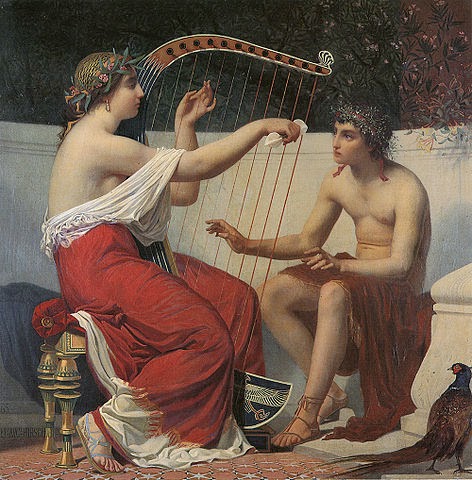
Calliope drops knowledge on Orpheus
Choose Your Muse: Calliope
Importantly, we also have the capital-C Calliope. She is The Muse of Eloquence and Epic Poetry.  With the slams that insist on coaching or curating the presenters, there is often better personal storytelling going on as well as the sets of inspired, touching, relevant and eloquent tales. Seemingly touched by Calliope herself, some of the storytellers in these slams create a wonder to hear and feel.  These Calliope[1] storytellers elicit a room-wide guttural sound of agreement or appropriate laughter from the audience immediately before they begin applauding. These good tellers are now the ones who inspire others to share their voices.

Take Some Action
Thinking that you want to be more on the Calliope side of things? Here are four actions you can take for improving your storytelling. First, get better coaching or (as a producer) offer coaching at your slams. Then, be more intentional about the stories you are telling. Also, be sure you have rehearsed your story with others who will actually give you authentic feedback.  Finally, explore some more options and educate yourself about how stories are actually crafted and created.

While the forms of both traditional and slam storytelling have their mixes of calliope and Calliope, I am happy to say that I think that more slams are evolving to the Calliope stage.

*****
[1]Or...go ahead and blow my alliteration by using the name of her son Orpheus should you need something more masculine.
Photo Cred:
calliope: By Neochichiri11 (Own work) [CC0], via Wikimedia Commons
Calliope: Alexandre-Auguste Hirsch [Public domain], via Wikimedia Commons
The is the official blog for K. Sean Buvala, storyteller and storytelling coach.

Wednesday, April 08, 2015

Storytelling Practitioner: What Does 'Show, Don't Tell' Mean?

Storytellers use too many words...sometimes.

In this next "Hard-Core Storytelling Practitioner" post, I am talking the concept of "Show, Don't Tell" (written as Show or Tell in this article) that is prevalent in the "sacred" texts (giggle) of many who practice oral storytelling.

Background
This is all Show. You would need some
Tell to understand this pic, huh?
I've been noticing lately in the audio recordings of our storytelling events that some of my stories might seem to be "missing" parts when listened to. However, I am not too concerned since the parts that are missing are the parts that I am "Showing" the audience the story rather than "Telling" the audience the story.

Adding to my reflection this week came Cassandra Cushing, who serendipitously asked on Twitter, "Storytellers, what does 'show, don't tell' mean to you? Do you like this phrase/concept?"

You can see most of the friendly conversation between Cassie, Tim Ereneta and me in this link here. In the debate for meaning and its application for oral storytelling, the "Tell" part of the phrase is easy: Words. Storytellers use words intentionally, judiciously and musically. But, don't use too many words, Show some words instead. Use too many words and, like extra salt in a soup, the experience of storytelling is spoiled. With not enough words, the story can feel flat just as soup would be when lacking salt.

So, for me, the question comes down to this: what does "Show" mean?

My Understanding
In the debate for meaning of "show, don't tell" and its application for oral storytelling, the "Tell" part of the phrase is easy for me: Words. Storytellers use words intentionally, judiciously and musically. They also need to do so in front of a live (present with them) audience. Because of that unique requirement of audience presence, the storyteller is free to Show the story through simple gesture and characterization.

I have a choice. I can Tell you a description of every character and how they are reacting to the world around them or I can Show how they are feeling and reacting in their story world.

Use too many words and, like excess salt in a soup, the experience of storytelling is spoiled. With not enough words, the story can feel flat just as soup would be when lacking salt. Tell the story, give enough narrative, walk with the audience towards the full realization of the story you are Telling. Use Show much more liberally. Watch your audience as you are storytelling, trust them to "get it." If they don't, maybe they need more salt in their soup?

Let's look at one character in one story, as an example of Show. When I tell one of the original Grimm versions of "Cinderella," the step-mother is clearly unhappy with Cinderella's ability to outsmart her. As she speaks in my story, demanding even more dried peas be picked from the ashes, I see her in my mind's eye. I Show that to my audience: my body straightens, her speech becomes clipped and she does the "plastic smile" at Cinderella. Her gestures become staccato and she unconsciously picks at her fingers, rubbing thumb to side of finger as she holds one hand in front of her. I am Showing the character to the audience. Step-mom's persona lives in me in these subtle ways.

Each character has their own "way of being" that is Shown in my way of bringing the character to life. This is so much a part of my telling that, in order to write this for you, I had to briefly tell the story to myself, so that I could remember the nuances of the character. I had to figure out how to tell you all those words to describe Step-mom in this article. Whew! Thank goodness I don't do that for actually storytelling.

Some Ways to Show
As a storyteller, you have a full pallet of ways to Show a character. You will be using hand gestures, facial expressions, gaze, and body posture and body position. Your tone of voice might change between characters. You will be being giving attention to your pacing, pauses and your eye contact. Incorporate the character into your being, Show the characters to your audience.

Exceptions
I am aware that for some audiences that may be visually challenged you may need to add more words to your story, using Tell more liberally. Also, for audience members on the Autism spectrum or others who have trouble with interpreting social cues, a more direct approach to "The Step-mom was angry, trying to control her voice…she sounded like this," might be a better choice. As storytellers, we always put our audience first. What do they need?

 But what about oral recordings?
These concepts of Show and/or Tell have different rules in a recording, particularly in an audio recording such as a CD, mp3, radio or podcast. Storytelling performances recorded in audio (or video) are not storytelling. They are records of a storytelling event, no matter how entertaining they may be. For example, my current version of the Rumpelstiltskin tale is of a tiny man of few words, but with a very expressive face, head gestures and lingering eye contact. That Showing simply does not translate well to an audio recording. To record it formally, I would have to change the balance and techniques of Show and Tell.

A story designed for recordings (audio) is closer to "voiceover" than storytelling.

Tl;dr or My Conclusion
Here is what I am practicing and using these days: Showing and Telling are both important parts of oral storytelling. Showing in a story is the whole body, subtle and nuanced, expression of a character or place in live storytelling. Telling is where the narrative takes over the story or the characters speaking things that move the narrative forward. I prefer that storytellers; Show me nuances of the character.

Edit April 10: Cassie Cushing has posted more on this subject on her blog linked here. 

******
The is the official blog for K. Sean Buvala, storyteller and storytelling coach. Photo Credit: Library of Congress, Prints & Photographs Division.

Monday, January 12, 2015

The Journeyman Storyteller: Ready for the Next Step?


Journeyman 1: The Oral Storytelling Realities

I've written a post that has a very specific audience: for those that are making some part of their livelihood as a working artist. Since it is more "insider" than other posts on this blog, I have published the entire article over at http://artistmarketingworkshop.com/storytelling-journeyman-ready/

Here is an excerpt from the long article. Please come take a look if it is of interest to you. Thanks. 

"There is a space in the arc of the careers of all performing artists where one transitions from wide-eyed beginner to being an effective, talented Master.  In between those two stages is the important step of Journeyman. . .


This article is very specific to the oral-storytelling journeyman. You have passed through those first apprentice-based stages, taken some of the good myths and standards of the art. Now you are stepping up into the day-to-day realities of making some of your income as an artist.


Here are a few of the myths (both implicitly and explicitly taught) that many next-level storytelling artists have found they have to work through:


1. Everyone is a storyteller!


2. Stories choose the storyteller.


3. Your storytelling should always make you feel good about yourself.


4. Do what you love and the money will follow.


5. If only X would happen, then I would be successful!


Finally. . .

As I write about these five very popular myths, I am more aware of one thing. . ."

I've also recorded this post as an audio file. Visit the page linked above to hear it. 


******
The is the official blog for K. Sean Buvala, storyteller and storytelling coach.

Wednesday, January 01, 2014

Getting the New Year in Focus

Heads up: this post is a bit more personal than what I normally post here. I'm writing more about the "artist" than the "art."

You might be tired of the New Year's posts, but I just wanted to share a thought that was new to me. It's not an idea that I thought up as I first heard it in a workshop from Trish Gillam at Gangplank Avondale. I've seen a mention or two since then in other places.

I'm not a fan of resolutions, even if I have written about them in the past. I find that people either "do" or "do not do" projects and ideas in their lives. However, I do like the idea of having a "theme word" for a year. As professional performing artists, I know it's easy for all artists to see grand possibilities about the future but forget that such possibilities need a firm foundation.

Now, my  2014 "theme word" is "organized." I let too much of 2013 get past me, for many legitimate reasons. At other times, I allowed myself to be overwhelmed by ideas and goals and then, in that mess of possibilities, I ended up not making anything happen.

This is not to say that 2013 did not have some good projects and surprises. 2013 did indeed have some unexpected-yet-good events. However, in being honest, I found that I lost momentum by not keeping a better reign on the structures of my work and art. In that, this was a rare year for me.

So, in this year as an artist, coach and family man, I will ask myself a question about the projects I choose and the activities I do: "Will this help me be organized?" An organized (not compulsive) working artist can achieve many goals and get projects done. This is not solely about being "neat" or "housekeeping;" rather it's about being together in mind and purpose.

My word for 2014 is "organized." No lofty resolutions in that one word but rather a need to see the top of my desk again, the transcendent side of my work as an artist expanding, books and projects completed, my calendar better filled with bookings, and my family still moving forward. There is no order to that list as I see it as an overall way of being rather than a list of  resolutions.

I hope this makes sense for you as a fellow artist or entrepreneur. If you chose a word that would describe your goals for 2014 what would your word be?

******
The is the official blog for K. Sean Buvala, storyteller and storytelling coach.

Monday, September 16, 2013

Storytelling Practitioner: How Does Pacing Work in Oral Storytelling?

I am spending some more time in the hard-core storytelling practitioner mode. My next thought: There are two ways to describe the pacing of your story.

First, pacing refers to how fast your story unfolds. Do you spend more time on some parts of the story and less time on other parts?  You may want to spend more time on one episode, piece or interaction in your story than another. Your audience will help you determine this. Although you may be telling the same story, the differences in your audience will help you to know when to focus more on part A or part B.

For example, when I tell my version of the "Fisherman and His Wife" to children, I will spend more time on the "funny" parts of the tale such as the fisherman and the fish speak to each other as well as the characteristics of how the wife reacts to each new change. When I tell the story to adult audiences, I will spend more time with the relationship between the fisherman and his wife. Since my stories are in episodes rather than a script, it is easy for me to change the pace at which each segment is revealed.

There is a second way to describe pacing in storytelling.  How fast you speak while telling the story? Mastering intentional pacing can help you create nuances in your story.

When you speak with a slower pace, you might be conveying the ideas of fear, anger, disbelief, astonishment, or awe.

When you speak very quickly you may also be sharing the emotions of fear, anger, excitement, energy, joy, surprise.

You will notice that I listed the words fear and anger for both slow and quick pacing.  Think about the following questions. What (or WHO) makes the difference in how those emotions are conveyed? Does it make a difference in who is being addressed? Does it make a difference in where the action is taking place?

Overall, most new tellers don't think about the ideas of pacing. They simply tell their story, with their pacing based on whether they are having trouble remembering the episodes (slow pacing) or just trying to get all the words out of their brain (fast pacing).

 Rather than just let your words fall randomly from your mouth, make intentional choices about how fast your characters speak


******
Sean Buvala is a storytelling coach and practitioner. He's the creator of the Storytelling 101 Elearning kit.

Monday, September 02, 2013

Storytelling: The Original Social Media (Tshirt Edition)

Isn't this the truth? The first true way to gather community was (and is) storytelling. Social interactions, education, training, passing on values and more come from the "social media" of stories and storytelling. We are just having some fun with a few Tshirt designs. Here's the first in the series. You can pick up this version until September 9, 2013. After that, you can sign up for the update list when new shirts in the series get released.
Store link is:  http://storytip.net/storymediashirt


******
The is the official blog for K. Sean Buvala, storyteller and storytelling coach.

Saturday, July 27, 2013

Storytelling Practitioner: Introducing Characters in Storytelling

Continuing my blog posts where I become your hard-core oral-storytelling practitioner, let’s talk about introducing characters in storytelling. I am writing about how to bring a character (person, animal, being) into your oral storytelling.

To consistently illustrate the techniques, I’m using the image of Jack, of “And the Beanstalk” fame, for this article. This process applies to any and every setting where you are telling stories, from business to bassinet.

1. Go with the literal “story” introduction.
Introducing Characters: Meet Jack
 Go old-school on your audience with the time-worn phrase. You know this one already.

“Once Upon a Time, there was a boy named Jack who lived with his mother in a very small house.”

Here you get right to the point, no need for the audience to catch up with you. Your audience does not need to guess what you are talking about as you lay out the scene. However, the “Once Upon a Time” lead-in will most likely cause your audience of business or teenage folks to mentally leave the room.

2. Use a situational introduction.

Start your story from anywhere but an expected beginning and put Jack in a situation that is from the depths of your story:

“From the middle of the tree-thick, reaching-to-the-heavens beanstalk, young Jack looked down upon the boyhood home that he still shared with his mother.”

Here the audience needs to work a bit harder as you give them something to process.

3. Share your character’s internal monologue.

We all have some type of self-talk. Share Jack’s in a manner like this:

“’What happens if I fall off this crazy plant? It was only a pile of beans yesterday. Mama is right: maybe I do need to think before I act.’ said the teenage Jack to himself, as he climbed the giant beanstalk growing outside the kitchen window of the cottage where he lived with his poor mother.”


Here you let us into the thinking patterns of your character, in most cases sharing with us their struggles. This type of intro is better for older audiences that have good abstract thinking skills.

4. Let another character talk to or about the character.

Let one character speak to another character about what they see, hear and feel.

“’ Jack, in your whole 12 years of your life, you have never done something this foolish. When you come down, I am locking you in your room for the rest of your life!’ screamed Jack’s mother as she stood outside of their small cottage. She was concerned, after all, as it was not every day that a boy could climb a beanstalk that reached to the sky.”

5. Compare the character to the audience.

Think about how the audience can relate to some aspect of the character and use that to connect the story to their experiences. For an audience of kids,

“Twelve-year-old Jack, in my story, may be just like you. He wanted to experience fantastic things. When he looked out the window of the cottage he shared with his mother, he saw the bottom of a giant beanstalk, thick as a tree and reaching to the sky. It was time for this poor boy to have an amazing adventure.”

Business Example.

Okay, you have twisted my arm. Here is one business introduction tied to the examples above. Remember, this is a hypothetical situation and I am writing words intended to be spoken aloud, not read.

“My client, Jerry Johnson, was leaning over the intensive-care hospital bed of his 25-year-old wife thinking that this type of illness only happened to ‘old people.’ It was really hard to clear his head of the ambulance siren from two hours ago and the beeping medical devices now.”

Do not get caught up in the formulas presented here, especially for business or corporate storytelling. They are guides. There is.no.storytelling.formula for everyone. Overall, your stories for business don't need to follow some "mythic journey." I will be writing more about that soon.

So, have we been introduced?


*****
This is the official blog of storyteller K. Sean Buvala. Learn more about his latest workshop at message15.com. Photo: Public Domain http://www.loc.gov/pictures/item/2002723369/

Friday, November 27, 2009

New FrogKisser Storytelling CD from Storyteller.net


Press Release Synopsis:

Storyteller.net releases a new storytelling CD titled "Frog Kisser" with stories including "The Frog Princess" and seven other tales of enchantments. Especially for adults and teens, the CD is available now from Amazon.com.

Avondale, AZ- Storyteller.net announces the release of their latest storytelling audio CD "Frog Kisser." "If you are looking for a story of the princess and the frog, we've have that as well as seven more unusual tales of enchantment and changelings," says Sean Buvala, director and producer of the CD. The "Frog Kisser" CD is now available at the FrogKisser.com website as well as Amazon.com. Featuring the work of seven unique storytellers from around the United States, the CD contains eight stories that are designed for adults, teens and tweens. Buvala, also one of the performers on the audio CD, continued, "All over the world, there are many stories of beings changed through love, commitment and challenge. In this CD, we have captured both world folktales and original stories to remind folks that things are not always as they seem." Comments from and about all seven storytellers are available at www.frogkisser.com.

"We know that in this 2009 holiday season, with the latest Disney animated movie, there will be renewed interest in the stories of enchantments. We created this CD so that folks who would like to explore great stories of changeling beasts can do so with a mix of traditional tales, original works and new perspectives on old themes," says Mr. Buvala.

The "Frog Kisser" project is a unique listening opportunity for fans of storytelling. "Our CD is unusual in the storytelling world. There have been very few collaborative storytelling projects like this at the national level, and nearly none that are aimed at a slightly older audience like 'Frog Kisser'," said Buvala. "I went to some of the best storytellers from our Storyteller.net site and invited them to join me on this new creation. We're very happy with how this turned out and I am looking forward to the next project and new discoveries with other good storytellers."

Sean Buvala, a 23 year veteran of national storytelling, is available for expert consulting and media interviews on the nature of storytelling, fairytales and legends connected with this project and all media releases based in story and storytelling.

Contact Information:

K. Sean Buvala
Available nationally for Radio, Print, TV interview
sean@storyteller.net
http://www.frogkisser.com
623.298.4548

###


The official blog for K. Sean Buvala, storyteller and storytelling coach.

Monday, August 17, 2009

Michael Vick Needs Storytelling: Healing and Apologizing with Story

Being truthful leads to reconciliation. Truth is expressed in the story of change.

Storytelling can be used for many different applications. One of the most difficult, but needed, application of storytelling is to express reconciliation, repentance and recompense.

Let’s look at real-life and very public example. As of this writing, professional football player Michael Vick is in the news as he tries to make a comeback after spending two years in jail, "doing his time" for the abuse and torture of dogs while funding illegal dog fighting. He’s on his own personal quest to be restored to his previous national career while trying to express that he’s learned his lesson, repaid his debt to society and is a new man.

Michael Vick needs to learn the art of storytelling. He needs to learn to tell the Truths he has learned. He needs storytelling to apologize.

Understand that I am appalled at his abuse of animals. However, after working many years as a professional listener in nonprofit human services, I have seen people who have committed awful crimes become contributing, forgiven role models who were/are able to positively impact the world around them. I have to assume that Mr. Vick will be in that category. Time will tell.

So, how does the Michael Vick(s) of the world seek this forgiveness? Well, along with contributions of time and treasure to causes that externally demonstrate their internal conversions, they need to craft their true story of their journey.

Here are six steps to creating the story for redemption.

1. Always tell the truth.
No mastery of storytelling techniques or communication skills will help if you aren’t ready to tell the truth about the past, present and future. When you need forgiveness and a second chance, you need to speak the truth. If not, you simply won’t have an audience when you are trying to get forgiveness the next time around.

2. Start the story with the vision of the future.
In essence, you will use your commitments to bookend your story with your vision to the new you of the future. Why? It is hard for an audience to truly listen to people they hate. By using this “bookend” technique, you allow your audience to immediately know you are ready to put your actions and not just your words into motion. For example, you might say "I know I have caused harm and pain, and I have already begun to support XYZ Organization with not only my money but 10 hours a week of volunteer time for the next few years.”

3. Acknowledge your "sin" against the world.
Be prepared to use the word "I" when speaking, not some generic "you." "I did . . . " is the correct phrase, not "sometimes you find yourself doing . . . " The use of "I" acknowledges and owns your failings. "You" means you are still not convinced of your failure.

For those of you who follow my storytelling training, you know I teach you how to break your stories into Episodic Telling. In your storytelling, some folks need to know more about your failure than others. In Michael Vick’s case, when he talks to others involved in dog fighting, his story will be more graphic. When talking to wayward youth, he might omit some details. An audience of PETA or animal-rights activists will require even different episodes.

4. Tell us about how you have paid your debt.
Let your audience know how the paying of that debt affected you both physically and emotionally. It’s time to dump the anecdotes and really talk about your life, your feelings, your fall. I’ve heard Mr. Vick say he was a jail janitor who made pennies per hour. That is only an anecdote. I don’t yet know how he felt; that will come from his storytelling. Tell me the story of working for pennies when you once had millions.
Caution! I am not talking about chest beating and crying on stage. Perhaps images of weeping evangelists come to mind? Although I want to know how you feel, I do not want you to use your story to dump emotion on me. Save that for your therapist . . . or court.

5. Express the actions you are taking now, in the present and future, that demonstrate how you have changed.
What are you doing now to create change in yourself and society? Here you are repeating the opening of your vision for your future. However, this time, do not just tell us about your thoughts, show us your feelings again. What have you learned? How has your "heart" changed? How is your life impacted and challenged because of your new actions?

Storytelling is not always used for fantasy time. Storytelling has been used always to teach and instruct. In some cases, when the desire to change is genuine, the power of storytelling can reconcile people and communities.

***
Sean Buvala is the executive director of Storyteller.net and an executive speaking coach training the use of storytelling to effect organizational change.


The official blog for K. Sean Buvala, storyteller and storytelling coach.

Wednesday, June 03, 2009

Sean Buvala Talks about Storytelling Techniques for Business Podcast (Guest Blog)

I was fortunate to be interviewed for the "Entrepreneur People" blog talk show. There is a great deal of good content in this interview, giving you an good overview of the power of storytelling techniques in business and non-profit groups. Sherry writes:

"Sean Buvala is a storyteller who teaches, speaks, and coaches organizations on the value of the story for understanding their culture, their people, and advancing their cause. Meet Sean and hear tips on the how and why of storytelling. www.seantells.net, www.storyteller.net, (33 minutes)"

You can listen in to the interview in the player below or go directly to the EP site at this link now.


To download the mp3 file, use this link here.


The official blog for K. Sean Buvala, storyteller and storytelling coach.

Friday, March 06, 2009

Are Videos Really Storytelling?

Over at Kathy Hansen's excellent blog, A Storied Career, she posted a very popular video that's floating around the Internet. It's a visual explanation of the financial crisis. I truly enjoy Kathy's blog and think she's one of the few quality and consistent bloggers for storytelling out there.

I disagreed, in this case, that the video was storytelling. Regarding the video and digital storytelling, my casual comments I left were:

It's informative.
It's useful.
It's fun to watch.
It's a great video experience.
It's educational.
It's a way to understand a complex subject.
It should be seen by many people.
It's something that I am glad that I watched.
It's something that deserves attention.

It doesn't need to tagged as storytelling to make it valuable. It stands well on it's own as a powerful video that serves a good purpose. It has value as art in its use of video.

If everything is storytelling, then nothing is storytelling.

It's not storytelling.

A hammer is no less a valuable tool just because it's not a screwdriver.

This video doesn't have to be storytelling in order to still be excellent.

And it is excellent.

Kathy, you have illustrated the a real issue: Just what is storytelling?

For me, storytelling takes people. I have videos on YouTube of me doing storytelling, but the videos are *not* storytelling. They are video records of my storytelling and they pale by compare to the video quality and technique of the above video you posted.

We do a disservice to both storytelling expertise and video expertise by not treating each to its own unique charism and definition.

I can talk about the financial crisis by retelling (speaking) the stories of others or using world tales to illustrate the meaning. A program of these stories, used to frame the video above, would be a powerful evening of conveying an idea through the dual communication methods of storytelling and video.

If I had to attach a shelf to a wall, I would have different tools to choose from based on how I wanted the shelf attached. I could use a hammer, screwdriver or glue gun, for example. Each is a different way of getting to the same goal.

If I had to talk about the financial crisis, I could choose different tools based on how I wanted the audience to understand the issue. I could use oral storytelling, writing, video or dance. Each is a different way of getting to the same goal.

I shall stop rambling now.

Let's stop calling all communication storytelling. Let's recognize that there are many ways to get a message out and storytelling, the one-to-one even-in-a-crowd oral technique (or ASL), is one very exciting way. Let's not dilute everything into one single pool called storytelling. Let's value the many ways to express story.

Having practiced and taught the art of storytelling for many years, I think it's the most effective and cost effective way to communicate. However, I know that all art forms (video included) are equally important contributors to the conversation.

By the way, add Kathy's blog to your regular reading. It's that good.

The official blog for K. Sean Buvala, storyteller and storytelling coach.

Wednesday, February 25, 2009

Press Release: "Bobby Jindal's Response Speech Demonstrates Business Storytelling Do's and Don'ts." says National Storytelling Expert.

Press Release
For Immediate Release

Avondale, AZ- National storytelling expert and speaking coach, K. Sean Buvala, reviews Bobby Jindal's "Republican Response" speech and offers four public-speaking tips gleaned from the Governor's presentation.

Buvala, the director of the national storytelling resource site at Storyteller.net, says, "Regardless of anyone's political preferences, the Governor's speech illustrates that stories and storytelling can be used in any type of important speech. As a corporate storyteller, I was happy to see yet another national figure make use of story in their presentation. I also think that any person using stories can learn four things from Mr. Jindal's speech."

Use intentional hand gestures. Buvala says, "The Governor uses frequent, choppy hand gestures that are synchronous with the syllables of the words he speaks. It looks as if he is conducting an orchestra or cutting onions to the rhythm of his words. Speakers should plan the gestures that they will use with their stories. These intentional movements can then enhance the stories being told instead of being a distraction."

Be careful when using "Me too" stories. Mr. Buvala continues, "While I appreciate and respect the Governor's family story of struggling immigrants, his narrative immediately following his comments regarding the president's family history both lessens and distracts from the power of the Governor's background story. In order to seem less like a 'me too' attempt at connection, the story might have served better at the end of the story. While it is a good thing that the Governor used stories, the placement of those stories must be carefully considered. "

Use tone and pacing appropriate for your audience. Buvala notes that, "Bobby Jindal's pacing, tone and inflection during his speech reminded me of a school teacher giving a motivational speech to young children rather than a thoughtful reaction intended for thinking adults. The constant head nodding, the sharp intake of breath between sentences and the higher pitch of his speaking took power away from his stories, perhaps making his narratives sound childish. I'd suggest that the Governor concentrate on slowing his pace, intentionally speak with a lower pitch and allow himself to breath deeply by using longer pauses more often.

Use stories to "frame" your presentation. "Finally," says Sean Buvala, "although Mr. Jindal's family history story might have been better placed in the speech, he does refer back to his opening story at the end of his presentation, when speaking again of his father's words. This process, called 'framing,' reminds the listeners of the central point of a talk, giving them a virtual 'frame' in which to see the ideas painted with the speaker's words."

Buvala, who teaches monthly public workshops for business storytelling, knows that stories used in national conversations help unify listening audiences. "Governor Jindal's use of personal stories allows the audience to understand the speaker as a human being rather than just a 'talking head' for an ideology."

For more information about group or private coaching in the art of storytelling for corporate or business use, please contact Sean Buvala via his website at www.seantells.net.

Contact Information:

K. Sean Buvala
www.seantells.net
(623) 298-4548
sean@storyteller.net

PO Box 392
Tolleson AZ 85353

"EXPERT CONSULTANT for the Press, Television and Radio"
Storytelling (both traditional and digital), performing artists, public speaking, corporate training, business coaching, non-profit organizations.

PROMOTIONAL PHOTOS
Promotional photos of Sean Buvala are available for download at:
http://www.seantells.com/seanbuvala_1.jpg
http://www.seantells.com/seanbuvala_2.jpg
http://www.seantells.com/seanbuvala_3.jpg
http://www.storyteller.net/sunwind/smallseanbuvala.jpg
http://www.storyteller.net/sunwind/largeseanbuvala.jpg

###


The official blog for K. Sean Buvala, storyteller and storytelling coach.

Monday, June 30, 2008

Free TeleConferences for July

I've just set up the dates for all the July 2008 Free Storytelling Teleconferences. Go to http://www.storytellerconference.com/ to register and learn more.

July 9 Wednesday:
"Will Your Clients Call You First? Ten Easy Ways to Stay In Their MindTops"

July 12 Saturday:
"So You Want To Be a Professional Storyteller?"

July 15 Tuesday:
"Storytelling 101: An Introduction to Storytelling for All Types of Storytellers."

July 16 Wednesday:
"Public Speaking 911: Five Fixes for Public Speaking Problems."

July 17 Thursday:
"So You Want To Be A Professional Storyteller?"

July 21 Monday:
"Public Speaking 911: Five Fixes for Public Speaking Problems."

July 24 Thursday:
"Making Your Storytelling CD (Right the First Time.)"

July 28 Monday:
"Will Your Clients Call You First? Ten Easy Ways to Stay In Their MindTops."

July 30 Wednesday:
"Storytelling 101: An Introduction to Storytelling for All Types of Storytellers."

The official blog for K. Sean Buvala, storyteller and storytelling coach.

Friday, February 22, 2008

Something's Cooking with Storytelling on Video and New Media

::facetious on::

Silly Tim. You can’t put storytelling on video and new media. “Everybody” knows that.

You know how I know? I look at the miserable failure of COOOKING on TV and the new media. Just like storytelling, audiences must be right there in the kitchenwhen cooking is happening. Just like audiences must be sitting in the tents when storytelling is happening.

Who in their right mind would put something like cooking on TV? For one thing, the audience can’t get the nuances. You can’t smell cooking on video. You can’t even TASTE the food on television. No one would be interested in that: pictures of cooking?

Oh sure, you could see and hear the cooking of great chefs, but you can’t really tell the exact way the cook holds the handles of the utensils or the fancy way they wiggle their eyebrows as they turn the stove fires higher. And, if the camera, moves away at the wrong moment, then you miss things. Cooking is all about spontaneity! If cooks planned when to look at the camera or to which camera they would be looking at, then it wouldn’t be real cooking any more, it would be some type of empty pie-shell of what real cooking is. Video would ruin cooking forever.

Besides, my grandmother used to cook like an angel. You didn’t see her doing cooking on television. Heck, she didn’t even own a TV and her cooking was just fine, thank you. Although, sometimes I wish I had her recipe for making polish sausages. You know, it was the kind made from scratch, ground right there in the kitchen, that only she could do? But she never documented how she did it. Nobody has the recipe.

And your foolish dreams continue- storytelling on video? Let’s think more about FOOD. NETWORK people don’t want to do cooking on TV, there is no money in it. Like a whole TV channel could be about food? The network would have videos and DVD’s for sale? Maybe the authors and cooks would have their own shows? What are you smoking..a turkey? Do you expect that maybe they’d sell more books or get more live appearances, maybe even sponsors? Would more people would start cooking and taking classes just because they saw it on this newfangled new media? Of course not!

Crazy talk, lad. Crazy talk.

I bet you think they should let just anybody watch their TV cooking programs, (where you can’t even smell or taste the food) and maybe even make copies of the shows they didn’t pay for? Downloading their recipes? Tim, stop this silliness. Those chefs would be so broke if they gave it all away.

And even if they were successful, they would tarnish their cooking with all that filthy money they made. And tarnish with with success...and with being able to make a living...and with being able to have a car that works...And with being able to do something about hunger.

If you put storytelling on TV and video, you’d have all kinds of problems. First off, you’d lose all the nuances and the spontaneity of storytelling.

And on this video and new media, how do we know they’d actually be doing Real Storytelling(tm) as officially sanctioned by the Dragon Tellers(tm) of America (tm)? Have you seen what skateboarders do with video? What would happen if kids could just record storytelling and start posting it? It would be like The Moth to the flame, I tell you!Dangerous.

And then, if people could see storytelling on video, they’d download all the stories in the world and then no one would come to any live storytelling events, let alone pay for any live storytelling. There would be no interest in live storytelling because they saw it all on TV. Just like cooking shows would be the end of cooking, storytelling shows would be the end of storytelling. And the end of making any living at storytelling.

But that is okay, because we are artistes! Money is dirty and marketing is only for the
selfish, crazy used-car-sales-like storytellers who use Email (and BLOGS!) to promote themselves. 30 years ago no storytellers even had Email or Blogs. All they had was hay! It is important that folks who like storytelling go back and touch that original hay ‘cuz that is where real storytelling started.

Please, Tim, stop all this dreaming. Cooking and Storytelling just aren’t meant for video and all this new media.

::/facetious off::

Image courtesy of Jacci Howard Bear http://desktoppub.about.com/
::The official blog of Storyteller K. Sean Buvala::