Showing posts with label professional. Show all posts

Sunday, October 04, 2015

So You Went to A Storytelling Festival...Now What?

So, you have been to a storytelling festival. What now?

Storytelling festivals and major conferences come in all shapes and sizes.If you have had the fun of attending one, you might be wondering "what now?" I have some suggestions that I think might help you explore the art of oral storytelling just a bit more. Below the picture are some notes and then a few specific items that might apply to you as a future "pro," should you be interested in exploring that option.

You can also listen to this post by the link at the end of the article.

1. Open your mind. Every festival or event has its own flavor, lens or world-view

As the director of Storyteller.net, I can usually tell when an event with a large attendance has completed and the audience has started to arrive home. How? I start to get Emails. Folks search the internet, find Storyteller.net and want to learn more about storytelling. Many times the questions in the Email are a variation of "How come there isn't (more about some subject) on Storyteller.net?"

I've been a featured teller at many gatherings and festivals. I have produced both large and small events. I can tell you this for sure: every event has its unique flavor, its own unspoken (usually) way of understanding the world. No matter how intently the event bills itself as "international," "national" or "fill in the name of the state or region," the event you were just at was driven entirely by the audience that attended the event. Everything about the event was planned for that audience. The festival or conference served those people- and you were one of them. Fantastic! Thank you for supporting the art form!

There's nothing wrong with this audience-based focus. It creates an invitation for you: go to more events!  You just dove in, you took the plunge and you found something new and exciting. Now, go find more. Travel, listen, tune in to the many and undeniably diverse expressions of oral storytelling in gatherings large and small. Attend the events that gather professionals that you will sit and watch. Attend events where everyone gets to be the teller and you (yes, you!) might have a chance to tell. You will be amazed at how much you will learn about yourself and the world around you when you open your mind to the breadth of oral-storytelling events.

2. Explore the variety of tellers that make up the oral storytelling world.

Many other Emails I receive contain a thought that is something similar to, "Your site doesn't feature Teller XYZ on the front page, the greatest storyteller on the planet!"

While we at Storyteller.net have featured many storytellers and have hundreds of articles, stories, podcasts and more from these tellers, it's important to remember that storytelling takes on many forms and sounds throughout the world. While one listener might believe that Teller XYZ is the source and summit of all things storytelling, there are thousands of other people who have not heard of Teller XYZ but yet are very much inspired by any of the other gifted and talented storytellers in their own city, state, region or country. The oral-storytelling world is still very much composed of many big fish in various little ponds.  You'll find that most of the big fish are actually very gracious and humble about their own work and would also encourage you to go about exploring other ponds. 

So, go do that. Dig around; find out just how much talent and craftsmanship there really is. Travel some distance in both mileage and philosophy. Be comforted and discomforted.  Take some risks; hear someone new across the city or across the country.

3. Support storytellers you like via events and products.

When you find storytellers you like, engage with them as much as you can. Join their newsletters, buy their books and CDs, and attend their workshops. It's not easy to make a living as an artist but yet you can give energy, love and support back to the artists you enjoy.  Visit their website, join their Email lists. Just engage. As an artist with many books, workshops and recordings, I am truly grateful for every bit of support given by my audience.  Please know that even just sending an encouraging Email (or posting an online review of their book or event) to the teller means much, too. You'll find that most oral storytellers are very accessible people, just like you.

However, maybe you have been inspired to pick up the mantle of "storyteller."  If you are looking to tell more stories in any setting, then here are a few more thoughts:

1. Read books and blogs. Go to workshops.

Immerse yourself in learning. Find the great books and training (if I say so myself) that can help you become a better storyteller. Here is a good start. Here is another. Here is a tips book. Here is another tips book.

Never stop learning. I've been at this art form since 1986. I still go to workshops and webinars, looking for at least one nugget of wisdom in each that will make me say, "That is why I came to this." Invariably, I find that nugget in every event. Imagine how much knowledge you can gain if you are just starting out!

2. Support other performers.

You will learn the most about storytelling at the events of other storytellers. Is there a local event happening and you aren't a performer?  Go to that event. Sit in the audience. Listen and enjoy. Be polite. Support the arts. If you are on the program at an event, stay for the entire program. Sit in the audience, don't hide backstage.

3. Gradually ramp into your professional status.

Good professional storytelling looks very easy to do. It's not. It's a craft and an art, perfected over time and practice. Before you launch into a new business of being a "professional" teller, be sure you have spent a good amount of time honing your craft in smaller events and venues. Get coaching- real coaching that gives you honest and clear feedback. Learn the Five B's of professional storytelling on any stage: Be prepared. Be good. Be heard. Be gracious. Be done.

You've been to a storytelling festival. That is wonderful. Now, keep on growing!
  ******
The is the official blog for K. Sean Buvala, storyteller and storytelling coach. Picture from Library of Congress.

Sunday, April 19, 2015

Storytelling Slams: Cocktails, Canapes and Calliope

Like me, a calliope is sometimes full of hot air.
A bit of personal reflection: "Cocktails, Canapes and Calliope" is the new way that I am understanding the ongoing evolution of the Story Slam.

There's been, in my little circles, some discussion by the oral storytelling community (both online and offline) about story slams. I've been reflecting, mostly for myself, on my evolving image of the story slam.

Story slams, henceforth just called "slams," vary in style, quality, rules, and process but most are built around telling personal tales that are supposed to be true. The sharing of personal stories has probably already existed since people learned to speak. Really, aren't slams just the extension of gossiping with your neighbor over the backyard fence in olden times, like 1970 or some such date? Slams, if nothing else, create self-selected communities when we are too busy to know the people who actually live in the homes next to us.  If you need to know more about slams, I've written about them here and here and always-teaching here.

In the most popular cases, these storytelling events usually are almost always held with food and drink (hence, "cocktails and canapes") for the audience. It seems, from my experience, that the best-attended slam events have these two elements. I'm wondering if this is unique to this version of storytelling (as a performing art) as I can't imagine that most folks go the ballet with a table of highballs and mixed nuts.

New Words
Lately, I am seeing some positive shift in the quality of these events.  I know that "quality" is subjective and personal, as for some people every word uttered on the slam stage should be applauded while others shun the entire reality of slams. However, balance is important.

I used to describe slams as "karaoke storytelling".  "Karaoke" was once the cocktails-and-canapes version of "everybody's-a-performer" event before slams started to take over. For many of the events I saw at the beginning of the story-slam trend (1998?), "Karaoke storytelling" was the right description in my mind. People readily understood the model: get up and talk (usually in anecdotes and not really in stories) about one of the big-three subjects of sex, drinking or nakedness (with a smattering of  "how crazy my family is") and you could get an ovation. Much like karaoke singing an off key-version of "Midnight Train to Georgia," you would at least get applause for your efforts and (important) your telling would embolden others to share their voices.

However, in the last year or so, I am seeing a positive shift in the quality storytelling at some slams. I'm replacing my use of the word "karaoke" with "calliope/Calliope."

first, it's a calliope
Let's start with the calliope with the small-c. A calliope is a loud, offkey, hot-air driven musical device that is used at circuses and state fairs. It's blustery, attention-seeking and, for a few moments, can be fun to watch. They are a novelty for music; they are not something I want to listen to all the time. Sadly, there is still some calliope-style storytelling going on at slams. While you can get a "ringer" who truly understands how to tell a story, there are still some storytellers who are new and loud. Worse yet is the storyteller who is not new, just lazy (untaught?) in story-crafting. This happens often in "draw the contestants' names from a hat" shows. These are the calliope storytellers. You will have some fun, but you will get tired of listening to these tellers after a while. There is much noise and distraction coming from these calliope tellers.  In fairness, we could say that there is some serious butchering of world-tale story in the traditional presentations, too.

Choose Your Muse.
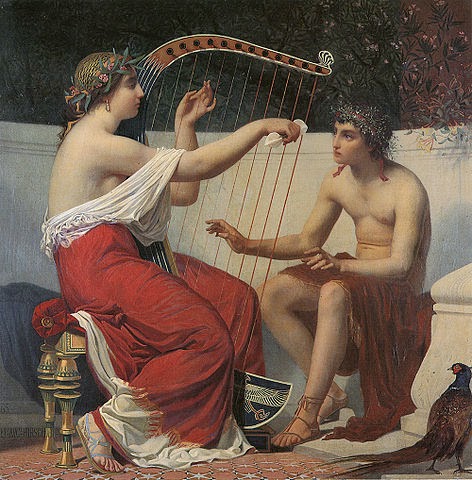
Calliope drops knowledge on Orpheus
Choose Your Muse: Calliope
Importantly, we also have the capital-C Calliope. She is The Muse of Eloquence and Epic Poetry.  With the slams that insist on coaching or curating the presenters, there is often better personal storytelling going on as well as the sets of inspired, touching, relevant and eloquent tales. Seemingly touched by Calliope herself, some of the storytellers in these slams create a wonder to hear and feel.  These Calliope[1] storytellers elicit a room-wide guttural sound of agreement or appropriate laughter from the audience immediately before they begin applauding. These good tellers are now the ones who inspire others to share their voices.

Take Some Action
Thinking that you want to be more on the Calliope side of things? Here are four actions you can take for improving your storytelling. First, get better coaching or (as a producer) offer coaching at your slams. Then, be more intentional about the stories you are telling. Also, be sure you have rehearsed your story with others who will actually give you authentic feedback.  Finally, explore some more options and educate yourself about how stories are actually crafted and created.

While the forms of both traditional and slam storytelling have their mixes of calliope and Calliope, I am happy to say that I think that more slams are evolving to the Calliope stage.

*****
[1]Or...go ahead and blow my alliteration by using the name of her son Orpheus should you need something more masculine.
Photo Cred:
calliope: By Neochichiri11 (Own work) [CC0], via Wikimedia Commons
Calliope: Alexandre-Auguste Hirsch [Public domain], via Wikimedia Commons
The is the official blog for K. Sean Buvala, storyteller and storytelling coach.

Monday, January 12, 2015

The Journeyman Storyteller: Ready for the Next Step?


Journeyman 1: The Oral Storytelling Realities

I've written a post that has a very specific audience: for those that are making some part of their livelihood as a working artist. Since it is more "insider" than other posts on this blog, I have published the entire article over at http://artistmarketingworkshop.com/storytelling-journeyman-ready/

Here is an excerpt from the long article. Please come take a look if it is of interest to you. Thanks. 

"There is a space in the arc of the careers of all performing artists where one transitions from wide-eyed beginner to being an effective, talented Master.  In between those two stages is the important step of Journeyman. . .


This article is very specific to the oral-storytelling journeyman. You have passed through those first apprentice-based stages, taken some of the good myths and standards of the art. Now you are stepping up into the day-to-day realities of making some of your income as an artist.


Here are a few of the myths (both implicitly and explicitly taught) that many next-level storytelling artists have found they have to work through:


1. Everyone is a storyteller!


2. Stories choose the storyteller.


3. Your storytelling should always make you feel good about yourself.


4. Do what you love and the money will follow.


5. If only X would happen, then I would be successful!


Finally. . .

As I write about these five very popular myths, I am more aware of one thing. . ."

I've also recorded this post as an audio file. Visit the page linked above to hear it. 


******
The is the official blog for K. Sean Buvala, storyteller and storytelling coach.