 |
| Like me, a calliope is sometimes full of hot air. |
There's been, in my little circles, some discussion by the oral storytelling community (both online and offline) about story slams. I've been reflecting, mostly for myself, on my evolving image of the story slam.
Story slams, henceforth just called "slams," vary in style, quality, rules, and process but most are built around telling personal tales that are supposed to be true. The sharing of personal stories has probably already existed since people learned to speak. Really, aren't slams just the extension of gossiping with your neighbor over the backyard fence in olden times, like 1970 or some such date? Slams, if nothing else, create self-selected communities when we are too busy to know the people who actually live in the homes next to us. If you need to know more about slams, I've written about them here and here and always-teaching here.
In the most popular cases, these storytelling events usually are almost always held with food and drink (hence, "cocktails and canapes") for the audience. It seems, from my experience, that the best-attended slam events have these two elements. I'm wondering if this is unique to this version of storytelling (as a performing art) as I can't imagine that most folks go the ballet with a table of highballs and mixed nuts.
New Words
Lately, I am seeing some positive shift in the quality of these events. I know that "quality" is subjective and personal, as for some people every word uttered on the slam stage should be applauded while others shun the entire reality of slams. However, balance is important.
I used to describe slams as "karaoke storytelling". "Karaoke" was once the cocktails-and-canapes version of "everybody's-a-performer" event before slams started to take over. For many of the events I saw at the beginning of the story-slam trend (1998?), "Karaoke storytelling" was the right description in my mind. People readily understood the model: get up and talk (usually in anecdotes and not really in stories) about one of the big-three subjects of sex, drinking or nakedness (with a smattering of "how crazy my family is") and you could get an ovation. Much like karaoke singing an off key-version of "Midnight Train to Georgia," you would at least get applause for your efforts and (important) your telling would embolden others to share their voices.
However, in the last year or so, I am seeing a positive shift in the quality storytelling at some slams. I'm replacing my use of the word "karaoke" with "calliope/Calliope."
first, it's a calliope
Let's start with the calliope with the small-c. A calliope is a loud, offkey, hot-air driven musical device that is used at circuses and state fairs. It's blustery, attention-seeking and, for a few moments, can be fun to watch. They are a novelty for music; they are not something I want to listen to all the time. Sadly, there is still some calliope-style storytelling going on at slams. While you can get a "ringer" who truly understands how to tell a story, there are still some storytellers who are new and loud. Worse yet is the storyteller who is not new, just lazy (untaught?) in story-crafting. This happens often in "draw the contestants' names from a hat" shows. These are the calliope storytellers. You will have some fun, but you will get tired of listening to these tellers after a while. There is much noise and distraction coming from these calliope tellers. In fairness, we could say that there is some serious butchering of world-tale story in the traditional presentations, too.
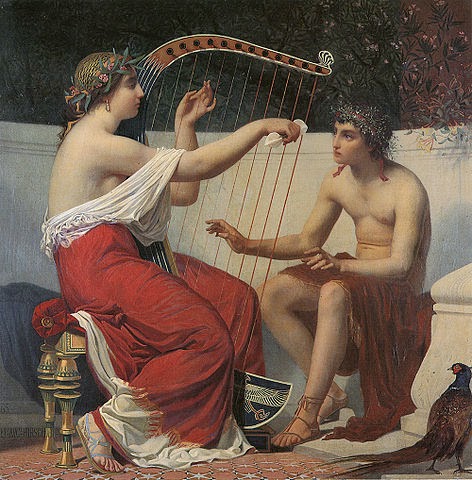 |
| Choose Your Muse. Calliope drops knowledge on Orpheus |
Importantly, we also have the capital-C Calliope. She is The Muse of Eloquence and Epic Poetry. With the slams that insist on coaching or curating the presenters, there is often better personal storytelling going on as well as the sets of inspired, touching, relevant and eloquent tales. Seemingly touched by Calliope herself, some of the storytellers in these slams create a wonder to hear and feel. These Calliope[1] storytellers elicit a room-wide guttural sound of agreement or appropriate laughter from the audience immediately before they begin applauding. These good tellers are now the ones who inspire others to share their voices.
Take Some Action
Thinking that you want to be more on the Calliope side of things? Here are four actions you can take for improving your storytelling. First, get better coaching or (as a producer) offer coaching at your slams. Then, be more intentional about the stories you are telling. Also, be sure you have rehearsed your story with others who will actually give you authentic feedback. Finally, explore some more options and educate yourself about how stories are actually crafted and created.
While the forms of both traditional and slam storytelling have their mixes of calliope and Calliope, I am happy to say that I think that more slams are evolving to the Calliope stage.
*****
[1]Or...go ahead and blow my alliteration by using the name of her son Orpheus should you need something more masculine.
Photo Cred:
calliope: By Neochichiri11 (Own work) [CC0], via Wikimedia Commons
Calliope: Alexandre-Auguste Hirsch [Public domain], via Wikimedia Commons
The is the official blog for K. Sean Buvala, storyteller and storytelling coach.




 Posts
Posts


