(Note: I wrote this for another website that wanted a quick article with this title. I'm sharing it with you, too. There may be a tidbit or two within it for you.
Public speakers can motivate, educate, challenge, and entertain audiences. The best public speakers can do all four at the same time. A good public speaker is flexible and enjoys each audience's diversity. It is an honor to speak with an audience; the best public speakers never forget that.
Always strive for excellence when you are speaking in public. In no particular order, here are 10 behaviors that public speakers should incorporate into their professional conduct.
A great public speaker. . .
1. . . .meets the audience.
When I speak at an event with other presenters on the schedule, I am always amazed that the speakers congregate backstage and away from the audience. While prep time is always needed before an event, make it a point to go out and casually mingle with the audience, listening more than talking. You will meet some great people, and more of the audience will feel like they already know you when it is your turn to speak on stage.
2. . . .knows their subject matter.
Speak about what you know and subjects that capture your energy and focus. You should know your subject well enough that you could spontaneously speak without notes in any situation. Be devoted to the subjects you speak about.
3. . . .uses sound equipment.
While ditching the microphone may seem more casual, I see and hear many speakers in my coaching work who insist they do not need a microphone. Making your audience strain to hear your words is not respectful. Any group gathering that cannot fit around a conference table will require a microphone.
4. . . .dresses comfortably for the audience.
Keep your clothing choices just a step above the casual or formal dress of the group. For example, if you expect an audience filled with blue jeans, you might choose business casual attire.
5. . .listens to other speakers.
Just as you want to meet an audience before events, it is important that speakers participate in those events. In particular, make it a point to hear the speakers before you on the schedule so that you can make good tie-ins with the group's experience.
6. . . .incorporates learning styles.
Not everyone in your audience can learn from a singular presentation style. Mix your presentation with audience activities, slides, stories, and direct input.
7. . .uses good speaking mechanics.
Are you using first-rate nonverbal techniques? Vary your pacing, tone, eye contact, gestures, and movement as your presentation progresses. Be interesting to watch.
8. . .customizes presentations.
It was popular advice a few years ago that you should be a speaker who developed a single presentation and presented that to every audience. In addition to being arrogant, it is rude to your audience and is a way to guarantee you will not be rehired. Tweak your presentations for each audience.
9. . .uses appropriate humor.
While the days of the "start with a joke" are well behind us, it is still good to use your own natural humor- staying away from traditionally sensitive topics such as religion or politics. Rather than try to be funny, simply share things that are funny to you and let the audience decide what they will laugh at.
10. . .shares good stories.
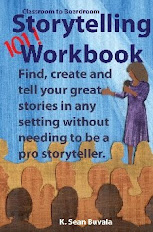
Good stories, used to illustrate your points, can help an audience remember your presentation. Be on the lookout for good stories from your own life and literature that can be used for future presentations. Learn good storytelling techniques to adjust each story for your audience. In my "Storytelling 101" Eworkbook, you can learn how to develop and present stories in a step-by-step manner.
Use this list as a place to start, but I encourage you to develop your own habits that will make you an excellent speaker.
***
Sean Buvala is a "hard-core how-to-do-storytelling coach" working and teaching internationally since 1986. He has served various clients with big names down to the smallest one-person business. He is an award-winning storyteller who can help you develop and fine-tune your business speech. To schedule your coaching session with Sean, fill out his contact form on his website at http://www.seantells.com.
Showing posts with label storytelling coach. Show all posts
Friday, October 28, 2011
Tuesday, August 09, 2011
New Book! "Measures of Story"
I've released a new book! For the next few days, you can get the book (Ebook or Kindle), a free teleseminar and the audio version of the book for just $6.97. Yes, that's just about giving it away. To get the teleseminar and the audio book, please order by the 11th. Details on the site.
I have a free chapter to read, a free chapter to hear, the table of contents to download all on the new website for the book. No registration is required for the free reads or audio.
Come grab your copy of "Measures of Story: How to Create a Story from Floats and Anecdotes." Features include:
*Explore the differences between stories, anecdotes and floats.
*Replace your archaic “elevator speech.” Understand why real stories make better communication tools.
*Learn the most overused floats that aren't the stories you might think they are.
*See how these anecdotes and floats become stories with examples for the personal and business world.
*Create your new stories with Sean’s “Take Action!” activities.
*Discover more online resources to help you learn to share convincing stories with associates, friends, students or family
Learn more:
http://www.howotcreateastory.com
******
The is the official blog for K. Sean Buvala, storyteller and storytelling coach.
Sunday, October 24, 2010
What is Storytelling: Thinking About What I Do
A friend of mine recently posted a small Facebook update about his work in pursuing his PhD. He is at the stage now where it is no longer just a dream but is actually close enough to be seen just over the metaphorical horizon. In his post, he posted the a long description of his PhD work and then tongue-in-cheek asked "And what are *you* doing?"
"What am I doing?"
That is not a hard question for me as a professional Storyteller. As well, to give credit, Limor's Storytelling Agora posting really pushed this post to the front for me.
What I am doing is
teaching all these folks with a "D" in their titles how to speak about their complex ideas so that the rest of the world can understand them. My clients come with all kinds of doctorates: JD, MD, PhD, PharmD, DMin and so forth.
I do not just train
the "D's" in storytelling technqiques. Some of my clients have "M's" and "B's" in their titles. Many have no titles at all. Some are still in elementary, high school or college.
What do I do as a storyteller?
Only a small percentage of my time as a working teller is actually involved in telling stories. Mostly, lately, I am training my clients how to speak their truths and content in a way that their audience can grasp and understand. As these others get the basics, the stories get deeper and more complex. Not everyone is a "D" nor should they be.
Complex ideas need to be expressed
in Story. Business to classroom to stage to home, I teach people to do just that.
This "how" is done through Story.
While I prefer storytelling, there are many ways to express Story. The new buzzword is "transmedia storytelling" As a storyteller and an artist first, I am open to the many ways to express Story, but only storytelling is storytelling. If you cannot see your audience and interact with them, allowing them to be cocreators in that singular moment of the Story, then you are not storytelling. You might be doing another equally important and useful art form. However, you will not be storytelling.
Let me clarify what I mean.
All dance is dance. But Tap dance is not Ballet. All Story is Story. Reading a book aloud is not Storytelling. These expressions of art are equal, different and needed.
Some of my expression of Story has been in writing.
My "DaddyTeller" book and workshops are a way to reach dads (moms, too) to urge them to fully engage with their children with by using storytelling. My "Storytelling 101" workbook is a bedrock "how to" of Storytelling essentials. My free Ecourse teaches folks some more tips for storytelling one piece at a time. I have written hundreds of articles and blog posts. I have two more books in different stages of development. I am the director of Storyteller.net where we were talking about storytelling online even before Google existed.
Back in 2008, I did a project
where I posted a near-daily update and picture of my work as a storyteller. It's at http://www.2008pics.com . That is a singular snapshot of one year. Every year is different. Every year has new clients. Every year is another unfolding of Story and storytelling for me.
I have been doing this since 1986.
I have paid my dues enough to be able to put forth theories, understandings and definitions. I am also enough of an artist to know that life is rather fluid and tomorrow is another chance to see what I have not seen before. You can agree or disagree with the ideas I have. It is okay
This post is not ego.
It is clarification for some future posts and projects. Storytelling has burned in my bones for 25 years and it has lit more than its share of fires.
I wonder
if this is an "Artist Statement?"
*********
The official blog for K. Sean Buvala, storyteller and storytelling coach.
Saturday, March 14, 2009
Storytelling Techniques in an Eworkbook from an Experienced Storytelling Consultant.
Would you like to start learning storytelling techniques- right now?
Wow! We've relaunched the "Storytelling 101" Workbook as an Ebook project. You now get immediate access to the workbook in a an immediate download. I am so happy about this new facelift to this project.
I have been a storytelling coach for a few decades and I understand what people want and need from a storytelling consultant. I've packed these exercises into this workbook and you can be learning from me in just a few minutes.
In addition, you get a chance to pick the brain of storytelling trainer: ME! Buy the book and you get free telephone story coaching with me. There are also two storytelling teleseminars included in the kit once you register your purchase.
I am very proud of how we could put this "storytelling consultant" idea into a downloadable Ebook.
Please come learn more at http://www.storytelling101.com. Your purchase is backed by a one-year 100% promise of satisfaction.
Thanks for your time. Come get my book. We've got this priced right now at an amount that I won't be able to offer for long.
By the way, you can get a free storytelling Ecourse from me. Just look over there in the sidebar to sign up. The Ecourse is not nearly as in-depth as the Ebook of storytelling techniques, but you'll still learn a bunch- and at no cost.
Thanks.
The official blog for K. Sean Buvala, storyteller and storytelling coach.
Subscribe to:
Posts (Atom)